


By 2026, Renforth Resources knew considerably more about the gold hundreds of metres beneath Parbec than it did about some of the gold sitting at surface.
That is a strange position for an explorer to find itself in.
Parbec was hardly unexplored ground. The Québec deposit already contained more than 360,000 ounces in its April 2025 resource estimate, with decades of exploration and drilling behind it. Yet when Renforth stripped away the overburden inside part of the proposed open-pit footprint, gold-bearing felsite and diorite appeared at surface more extensively than the company had previously understood.
Then came the channel samples.
One returned 2.97 g/t gold over 10.2 metres. Another ran 8.02 g/t over 2.55 metres, including 28.77 g/t over 0.6 metres.
There was already plenty of gold in the Parbec model. The interesting part was the gold sitting outside its expectations.
When the Numbers Stop Being Final
The precision of a resource estimate can disguise what it actually represents: a geological interpretation frozen at a particular point in time. Change the information underneath it and the picture can move.
At Parbec, the April 2025 estimate contains 265,800 ounces in the Measured and Indicated categories and another 97,000 Inferred ounces. Within the open-pit model, 9.61 million tonnes of M&I material averages 0.86 g/t gold.
Of the Inferred resource, 48,100 ounces sit within the underground component at 1.98 g/t gold, more than twice the grade of the open-pit resource.
The 2026 fieldwork has given Renforth new information to put against those numbers.
When the Model Meets the Rock
The significance of Channels 51 and 58 lies less in their headline grades than their location.
Renforth stripped ground within the footprint of the existing Parbec open pit and exposed sediments, diorites and felsites. According to the company, gold-bearing felsite and diorite occurred to a greater extent than previously understood. Five of eight initial channels subsequently returned gold above the 0.27 g/t cut-off used in the 2025 resource model.
There is now a gap between what Renforth can physically see at surface and what its existing model consistently shows.
The company has begun folding the 2026 surface work, historical information and new drilling into an updated internal geological and resource model. The exercise remains internal and should not be confused with a new NI 43-101 mineral resource estimate.
Surface channels can establish that gold exists in the exposed rock. They cannot establish what happens beneath it.
For that, Renforth needed to drill.
Now the Drill Has to Answer
PAR-26-149 and PAR-26-150 were completed in August as undercuts beneath the surface channel intersections, while also testing deeper targets. They were the first holes drilled at Parbec since 2022.
Their job is straightforward: determine whether the mineralisation exposed at surface continues into the system below.
PAR-26-149 has already supplied one visually intriguing detail. Four fine flecks of visible gold were identified in a quartz-albite veinlet at approximately 263 metres downhole.
Visible gold photographs well. It does not settle geological arguments.
Renforth has been explicit that visible gold is atypical at Parbec and is neither correlated with nor indicative of grade. The assay laboratory gets the final word.
Those assays remain outstanding.
If they return meaningful mineralisation beneath the surface discoveries, their significance will extend beyond two drill intersections. They would begin connecting the geology exposed in 2026 with a mineralised system the existing model may not fully describe.
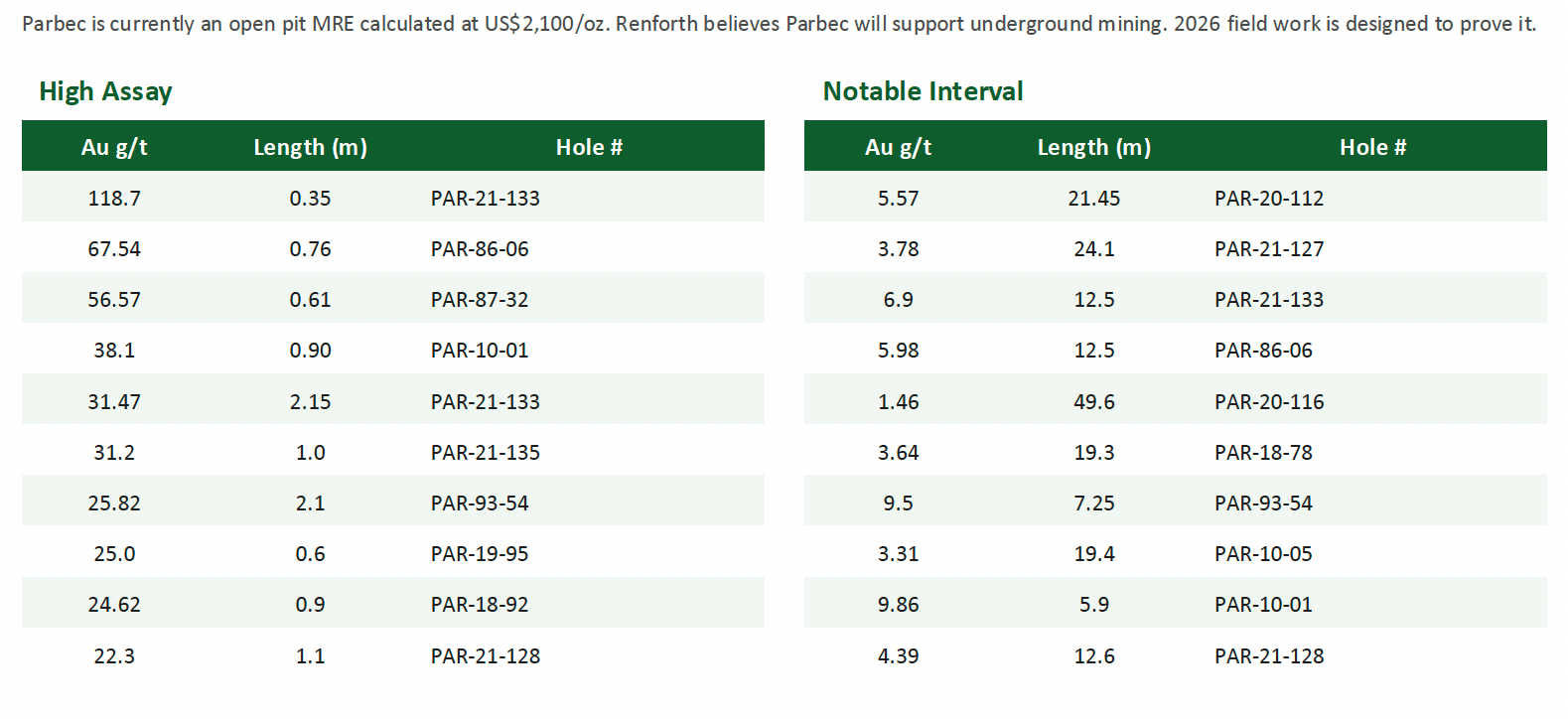
Parbec has already produced enough historical drilling to show that meaningful widths and locally high grades occur within the system. Previous intersections include 5.57 g/t over 21.45 metres, 6.9 g/t over 12.5 metres and 31.47 g/t over 2.15 metres. The question facing the current programme is where the newly exposed surface mineralisation fits within that picture.
The Economics Have Moved Too
The April 2025 estimate used US$2,100 gold in its cut-off and net-smelter-return assumptions. Renforth has said its internal review will use a current gold price alongside updated operating-cost assumptions.
Higher gold prices do not turn resources into reserves, nor does multiplying ounces by spot gold produce a meaningful project valuation.
But Parbec is now being reconsidered with a different geological dataset and different economic assumptions from those used to build the 2025 estimate.
Renforth identifies three gold settings across the property. Zone 1 contains most of the existing resource along the Cadillac Break. Zone 2 is sediment-hosted and has produced a surface channel result of 1.43 g/t over 12 metres. Zone 3 is a deeper structural target where mineralisation has been encountered as deep as 738 metres.
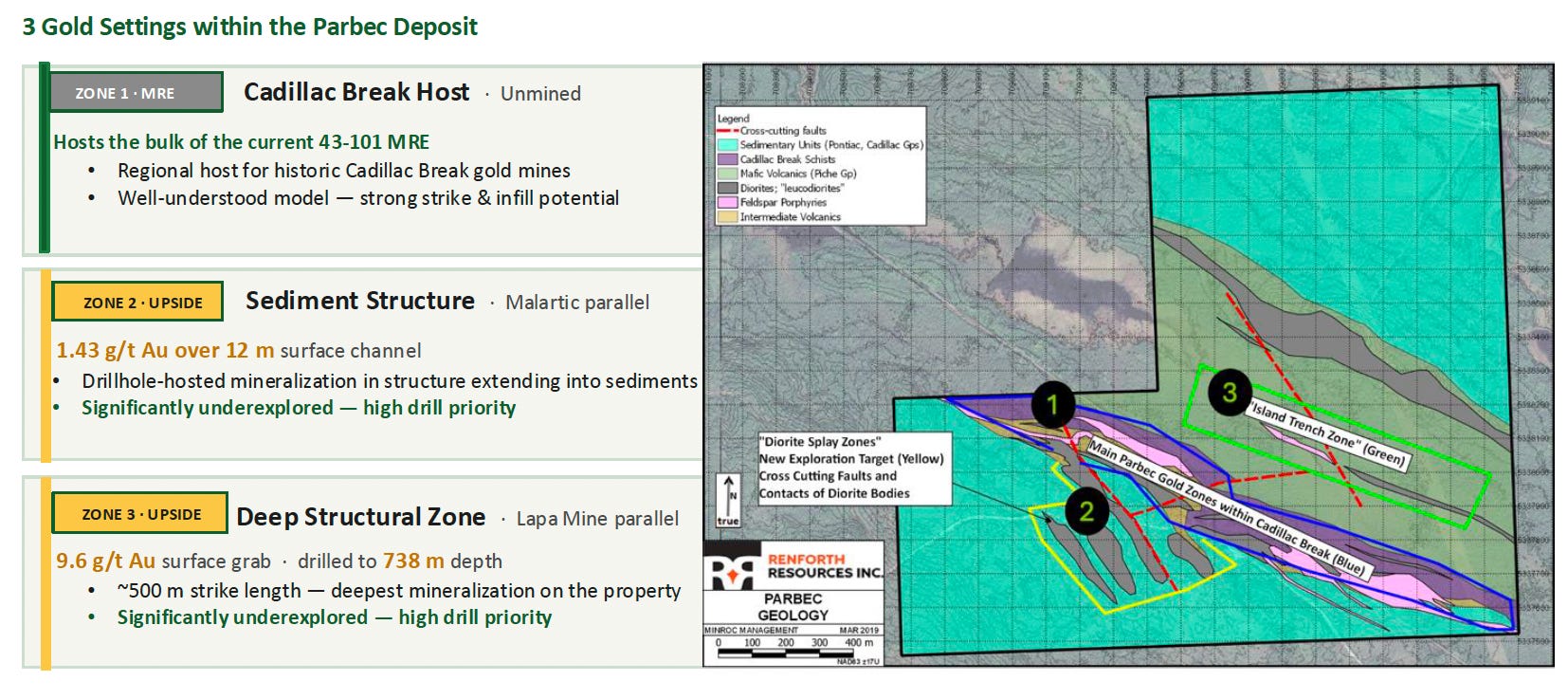
The work is moving beyond adding incremental ounces around an established block model. Renforth is still establishing how several mineralised settings across Parbec fit together.
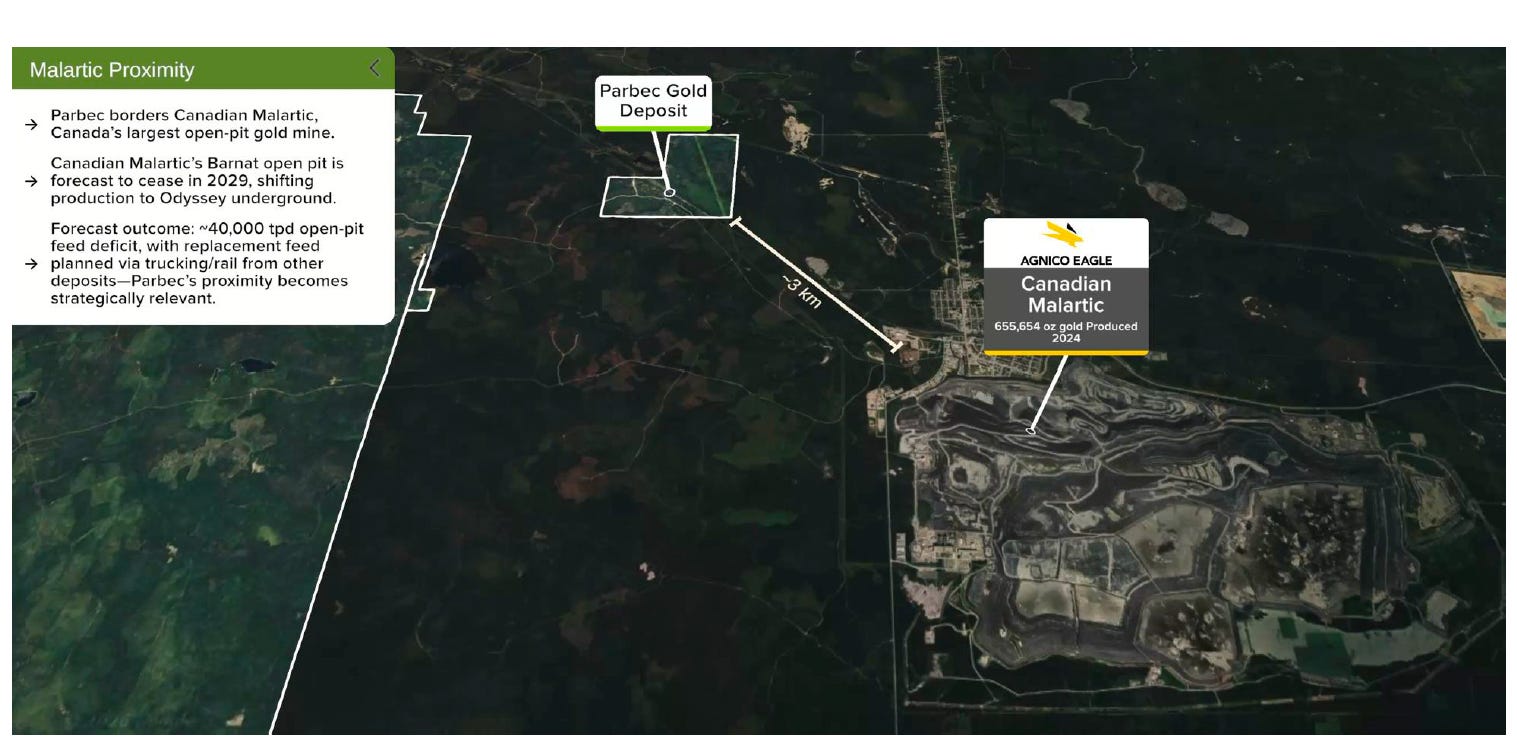
Parbec is contiguous with the Canadian Malartic property, while a hydro powerline crosses Renforth’s properties and road access already exists within an established mining district. An underground decline built in the 1980s remains on the property. Renforth wants to dewater and access it for further investigation, potentially including a bulk sample.
For a junior explorer, that changes the nature of the problem. Renforth is not starting with an isolated discovery and wondering how infrastructure might eventually reach it. Some of the physical groundwork is already sitting on the property.
How far Renforth takes the revised interpretation remains open. The company has completed a QP site visit and witness sampling, giving it the groundwork required to support public disclosure should it choose that route. For now, the exercise remains internal.
And Then There Is Victoria
Parbec is not Renforth’s only resource.
Victoria, its polymetallic deposit elsewhere in the Malartic district, contains an initial Inferred resource of 125 million tonnes grading 0.15% nickel equivalent, representing approximately 413 million pounds of contained NiEq across nickel, copper, cobalt, zinc and silver. That resource covers roughly 2.5 kilometres of a mineralised structure extending for approximately 20 kilometres.
For now, Victoria is the optionality sitting behind the more immediate question at Parbec.
Victoria can wait. The immediate test is at Parbec.
Renforth already knows there is gold there. The 2025 resource established that. It knows gold occurs at surface because the company has stripped the ground, exposed the bedrock and sampled it. The outstanding question is whether PAR-26-149 and PAR-26-150 connect those surface discoveries with the mineralised system below, and whether that connection is significant enough to change the model built around it.
Exploration usually advances by drilling deeper, collecting more data and building increasingly elaborate models. At Parbec, the latest complication arrived when Renforth removed a layer of earth from ground it thought it already understood.
The rock underneath did not quite fit the picture.
Renforth has stripped away the overburden.
The next assays will tell us what, if anything, it also stripped away from the old interpretation.
Disclosure: This article has been commissioned by Renforth Resources Inc. (CSE: RFR). The views expressed are that of Matt Oliver, Oliver Mining Network and reflect his own analysis. This article is provided for informational purposes only and does not constitute financial or investment advice. Investments are inherently speculative and involve risk, including the loss of capital.