



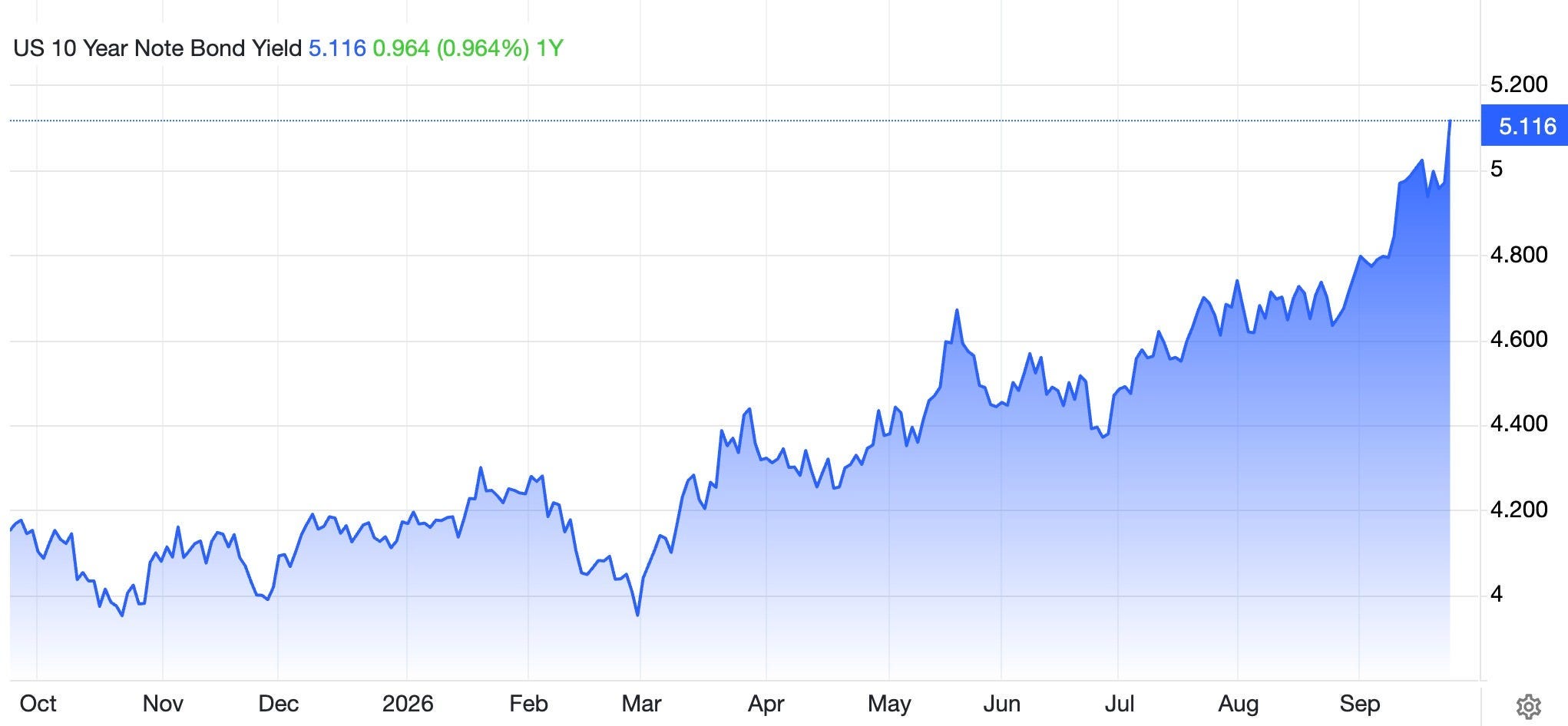
On 23 September, the United States government attempted to borrow $70 billion from investors for five years. It succeeded, as it always does. The interesting part was how much it had to pay.
The notes cleared at 5.033%, their highest auction yield in roughly two decades and 64 basis points above the equivalent sale just four weeks earlier. Foreign investors, traditionally among the Treasury’s most dependable customers, were conspicuously less enthusiastic. Indirect bidders took just 54.3% of the offering, their smallest share since March 2020, leaving primary dealers holding an unusually large portion of the debt.
The following afternoon, thirty-year Treasury yields touched 5.501%, their highest since 2004.
Washington could still borrow. It was simply finding that its creditors wanted considerably more for the privilege.
Ordinarily, higher yields should make government bonds more attractive. A saver can now earn around 5% by lending to the American government, an income that gold cannot provide and Bitcoin cannot promise.
Yet the September auction exposed an uncomfortable contradiction. Investors were demanding substantially greater compensation to hold an asset that financial markets continue to describe as risk-free.

When 5% Isn’t Enough
Government bonds have occupied a privileged position in investment portfolios for generations. They provide income, liquidity and a contractual promise of repayment. During financial crises, investors have traditionally sold riskier assets and purchased Treasuries, confident that the American government would honour its obligations.
That confidence has survived wars, recessions, banking failures and extraordinary monetary experiments.
American federal debt has exceeded $40 trillion. The Congressional Budget Office recorded $963 billion in net interest payments during the first ten months of fiscal 2026. Every refinancing at today’s higher yields increases the expense of servicing obligations accumulated when money was far cheaper.
Washington must eventually find the money somewhere. It can collect more taxes, reduce spending or borrow further. None is particularly appealing to an electorate accustomed to government promises.
Inflation offers another, less conspicuous escape.
Debts remain payable in their original currency, even when that currency purchases less than it did when the money was borrowed. Creditors receive their coupons and principal exactly as promised, while the real value of those payments gradually deteriorates.
Bondholders therefore face two separate hazards. Rising yields reduce the market value of existing securities, particularly those with long maturities. Persistent inflation threatens the purchasing power of the money eventually returned.
A thirty-year Treasury purchased in May 2020 was trading around 45 cents on the dollar in August. The American government had not defaulted. The investor’s capital had suffered an extraordinary decline in market value.
Higher yields can make gold less attractive when they reflect improving real returns and confidence in monetary stability. But a 5% yield demanded because investors fear inflation, fiscal deterioration or further debt issuance is much less reassuring.
The interest becomes compensation for the very uncertainties that gold investors are trying to avoid.
Who's Lending to Washington?
The September auction was revealing because of who appeared increasingly reluctant to lend.
China’s Treasury holdings had fallen to approximately $618 billion in July, less than half their November 2013 peak. Japan, still America’s largest foreign creditor, had also reduced its position as pressure on the yen and rising domestic yields complicated the attraction of holding American debt.
These countries have spent decades recycling trade surpluses into US government securities. Their purchases helped finance American deficits while reinforcing the dollar’s international position.
The arrangement is becoming less automatic.
As traditional foreign demand weakens, other investors must absorb the supply. Hedge funds’ long Treasury exposure has risen from roughly $600 billion in 2014 to $2.4 trillion by the end of 2025.
Much of this activity involves leveraged trading strategies dependent upon cheap short-term financing. Buyers can provide substantial liquidity in ordinary conditions, but they are also vulnerable when funding costs rise or market volatility forces positions to unwind.
The Treasury market remains enormous and indispensable. Yet there is something absurd about a financial system that relies upon leveraged hedge funds to support the market against which every other asset is measured for safety.
Bitcoin's Unfinished Experiment
The dissatisfaction with conventional money helps explain Bitcoin’s appeal.
Its fixed supply offers an attractive contrast with currencies that governments can expand. Its decentralised architecture allows ownership and transfers without relying upon a central monetary authority. For investors who watched successive rounds of quantitative easing, the attraction was understandable.
Institutional adoption has since carried Bitcoin into mainstream portfolios. Exchange traded funds, custodians and established financial institutions have made access considerably easier.
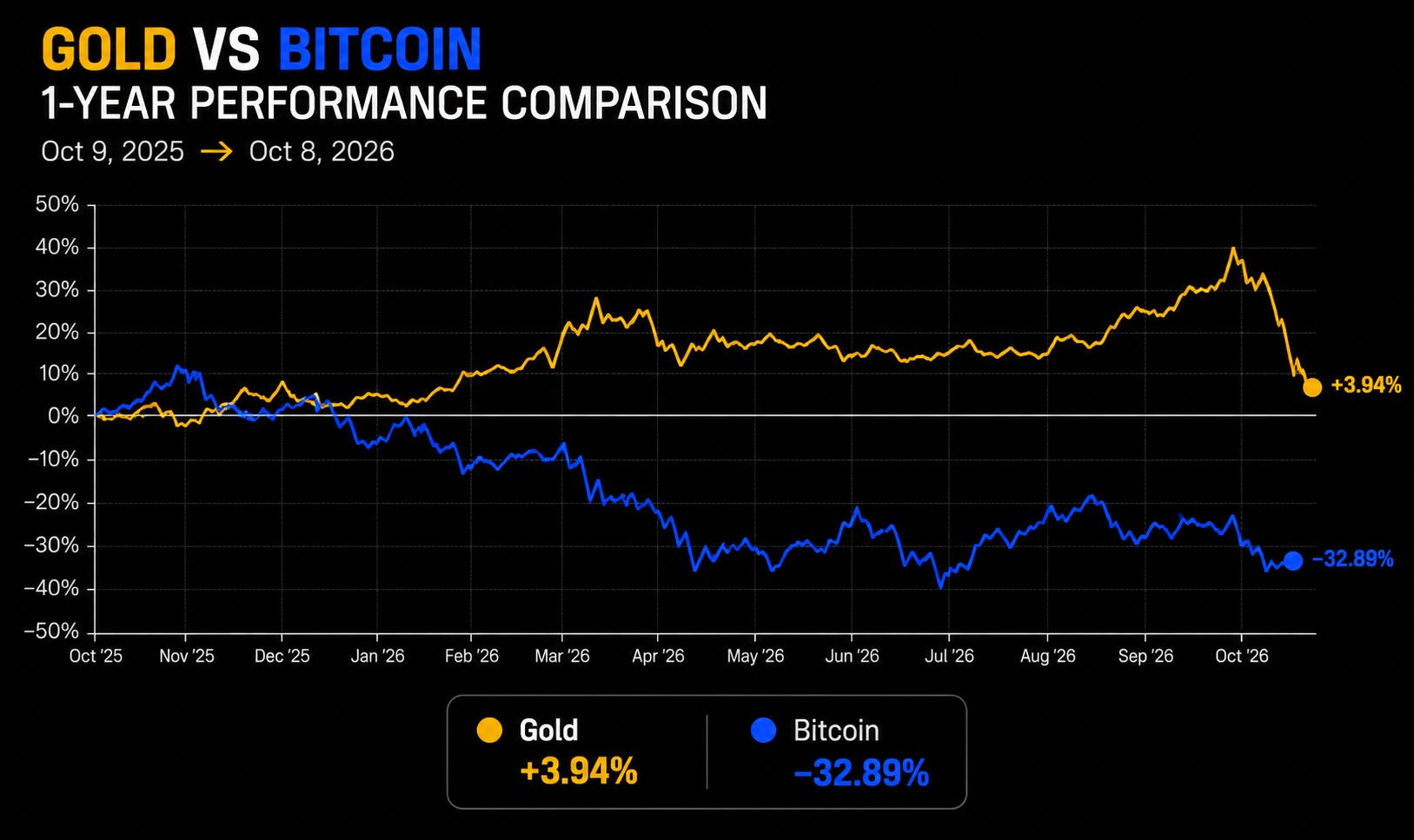
Its price, however, continues to behave like that of a speculative asset.
Bitcoin can appreciate spectacularly when capital is abundant, then suffer severe declines when financial conditions tighten. After more than fifteen years, its value remains heavily influenced by liquidity, positioning and investors’ willingness to tolerate volatility.
An asset capable of losing half its value within months presents obvious difficulties for somebody protecting retirement savings or setting money aside for a future financial obligation.
There is also an irony in its institutional evolution. Many investors now own Bitcoin through the same brokers, funds and custodians from which its original supporters hoped to escape.
Direct ownership offers greater independence, although it requires secure private-key management and functioning digital infrastructure.
Bitcoin may continue attracting capital and delivering extraordinary returns. Its scarcity is genuine within the rules of its network. But price appreciation tells us little about whether an asset can reliably preserve purchasing power when its owner needs it most.
Central banks have largely avoided the experiment.
They continue buying gold.
Cash Has Its Place
Cash is less exciting, although its usefulness becomes obvious whenever something goes wrong.
A family needs accessible savings for unexpected expenses. Businesses require liquidity to meet wages, rent and operating costs. Investors holding cash can navigate market declines without selling long-term assets at distressed prices.
Physical banknotes offer another advantage. They remain usable when payment networks fail, internet connections disappear or access to digital banking becomes temporarily unavailable.
These are ordinary considerations, easily forgotten by a financial industry preoccupied with returns.
Yet a banknote offers no protection against the gradual erosion of its purchasing power.
Someone holding £10,000 in physical cash will possess exactly the same nominal amount five years later. If living costs rise substantially, that money will buy less food, energy, housing and transport.
Interest-bearing deposits can offset some of the loss, although returns fluctuate with monetary policy and may fall short of inflation after tax.
Cash earns its place because nobody can predict when they will need it. The difficulty begins when money intended for immediate security becomes the foundation of a long-term savings strategy.
Beyond Another Government's Promise
Central banks face a more complicated version of the same problem. Their reserves must remain useful across political cycles, monetary regimes and, occasionally, international conflict.
The freezing of Russian foreign-exchange reserves in 2022 demonstrated how quickly financial ownership can become entangled with political authority. Assets held within another country’s financial system could become inaccessible through decisions taken thousands of miles away.
For countries already uncomfortable with their dependence upon the dollar, the lesson was difficult to miss.
China and other reserve managers have consequently had additional reasons to reconsider their exposure to foreign sovereign liabilities.
Gold offers a form of ownership that does not require another government to repay a debt. Physical bullion held under direct control carries no maturity date, cannot be issued to finance a fiscal deficit and does not depend upon the continued operation of a particular payment network.
Its price can fall, sometimes sharply. Storage and security involve costs. Gold provides no income while investors wait for its monetary characteristics to become relevant.
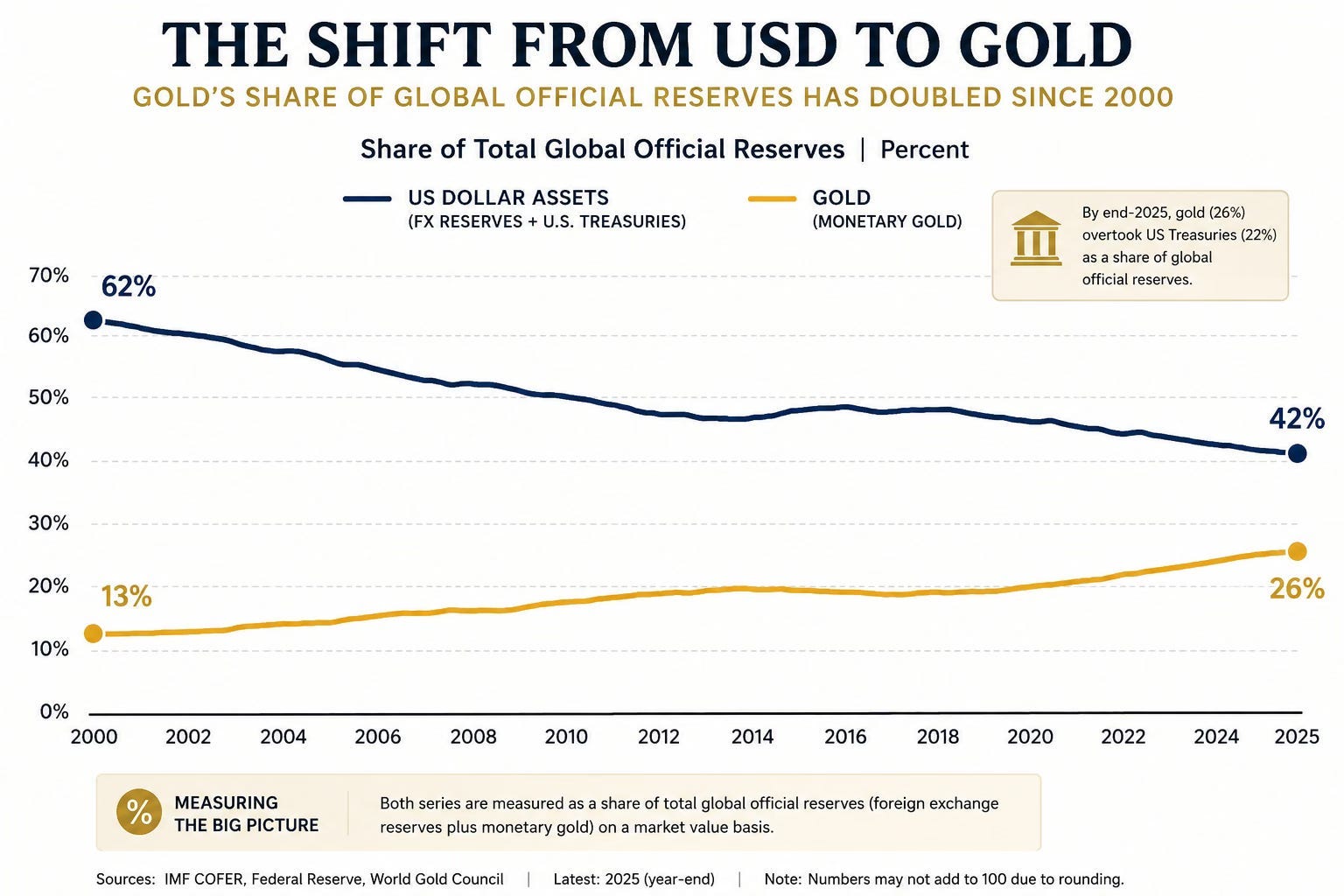
Central banks have nevertheless continued accumulating it at historically elevated rates.
These institutions have access to the world’s deepest bond markets, sophisticated currency operations and financial instruments unavailable to most private investors. They understand perfectly well what interest income they are sacrificing.
Their behaviour suggests that some risks are becoming expensive enough to justify foregoing it.
What the Auction Revealed
The American government remains capable of borrowing on a scale that few other countries could contemplate. The dollar dominates global trade and finance, and Treasury securities continue to perform essential functions throughout the banking system.
Predictions of their imminent disappearance remain unconvincing.
But September offered a glimpse of a less comfortable arrangement.
Washington wanted $70 billion for five years. Investors supplied it, although at a substantially higher price than the previous month, with traditional foreign demand showing signs of fatigue.
The same financial system offers savers cash that gradually loses purchasing power, government bonds whose market values can collapse without a default, and a digital asset whose extraordinary returns come with equally extraordinary uncertainty.
Each has a legitimate purpose. Cash meets immediate obligations. Bonds provide income and contractual payments. Bitcoin offers exposure to an emerging form of digital scarcity.
Gold pays nothing, matures on no particular date and can spend years disappointing investors who expect immediate results.
Yet central banks continue adding it to their reserves.
At September’s auction, the world’s most powerful government discovered that lenders wanted more money for holding its promises.
Gold has never needed to make one.
If you are thinking about how to protect your wealth in this environment, you can explore physical gold and silver through www.goldwise.com, where the focus is on ownership, security and transparency.
Goldwise are committed to producing educational content that helps investors better understand the macroeconomic forces shaping financial markets. If there are topics you would like us to explore in future editions, we welcome your feedback.
Disclosure: Mr. Matthew Oliver, Oliver Mining Network, is a shareholder in Goldwise. Any opinions, analysis and views expressed in this publication are solely those of Mr. Matthew Oliver and Oliver Mining Network and are provided independently unless expressly stated otherwise.
This publication is provided for informational and educational purposes only and does not constitute financial, investment or other professional advice. References to Goldwise are for informational purposes and should not be construed as a recommendation to purchase any product or service. Investments can fall as well as rise in value, and readers should conduct their own research and, where appropriate, seek advice from a qualified financial adviser before making any financial decisions.