



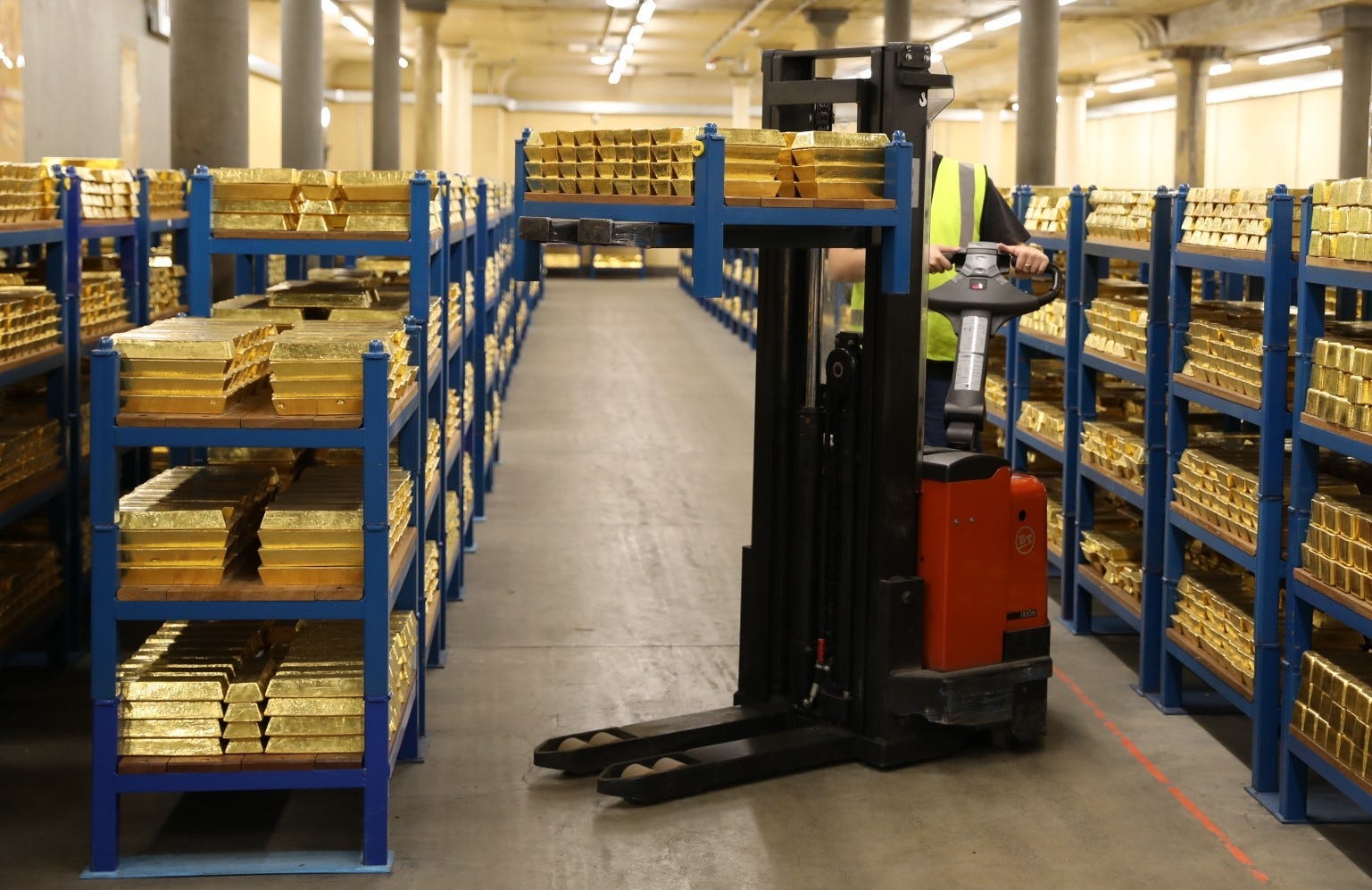
Somewhere beneath London, a 12-kilogram gold bar is sitting in a vault.
It carries the stamp of an approved refiner and is worth hundreds of thousands of dollars. Somewhere else, a trader in New York is buying a futures contract representing 100 ounces of gold without ever expecting to see a bar. A bank in London is quoting a client a price for gold that will settle two business days later. An investor in Britain is ordering a one-ounce Britannia from a dealer at several percentage points above the number appearing on Bloomberg.
All of them are trading gold. None of them is necessarily trading at exactly the same price.
Ask which of them sets the gold price and none can quite claim it. There is no official sitting in London deciding that gold should be worth $4,000 an ounce. There is no single exchange with authority over the world market. London bullion, New York futures, institutional derivatives and physical metal trade alongside one another, tied together by arbitrage.
The Miner Doesn’t Name the Price
Before an ounce reaches London, somebody has paid to drill, blast, haul and process the rock containing it. Labour must be paid. Diesel must be bought. Equipment wears out. Royalties and sustaining capital accumulate. Yet when the resulting gold reaches the market, the miner has remarkably little say over its price.
Newmont reported 2025 gold all-in sustaining costs of $1,358 per ounce on a by-product basis. Agnico Eagle reported $1,339. Newmont’s 2026 guidance subsequently rose to $1,680. Gold does not obediently trade at those figures plus a reasonable profit margin.
The mine is largely a price taker.
Its gold usually leaves as doré, an impure mixture containing gold, silver and other material. At the refinery it is melted, sampled and assayed. The refiner establishes how much gold is actually there, refines it to the purity required by the wholesale market and pays according to the fine ounces recovered, generally referencing the prevailing market price.
Mining creates the gold. Refining establishes its quantity and purity. Neither process decides what an ounce is worth that afternoon.
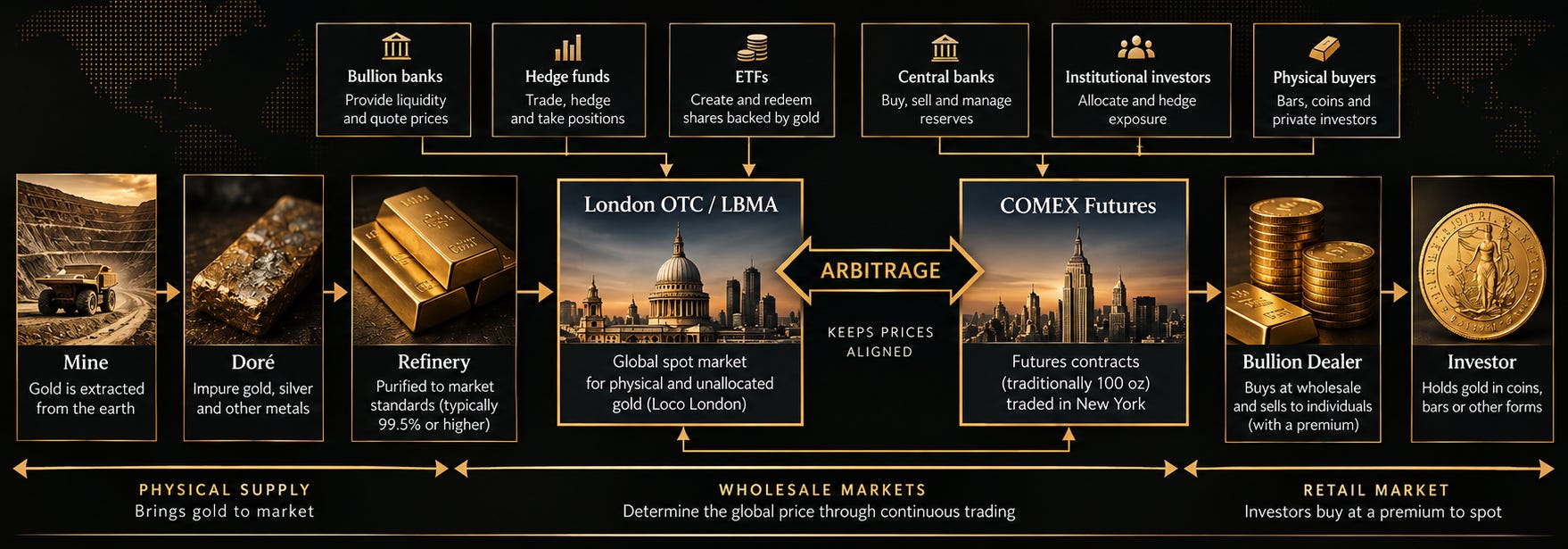
A Price Without a Price Setter
The number most investors watch is the spot price.
A wholesale gold quote refers to a fine troy ounce, 31.1035 grams, with London serving as the market’s standard delivery location. The familiar wholesale price describes something quite specific: gold meeting recognised standards, delivered through the Loco London system.
Inside that market, bullion banks and other market makers continuously quote two prices. The bid is what they will pay. The offer is what they will sell for.
Suppose one dealer quotes gold at $4,400 bid and $4,404 offer. Another might quote $4,401 and $4,405. The single gold price appearing on a financial website compresses this moving two-sided market into one convenient number.
Those quotations respond continuously to orders, currencies, interest rates, financing costs, futures prices, inventories and the dealer’s own exposure. An IMF analysis using LBMA data estimated average daily London gold turnover at roughly $134 billion.
The negotiation continues trade after trade, across a market turning over more than $100 billion on an average day.
When London and New York Disagree
In New York, the COMEX benchmark gold futures contract represents 100 troy ounces. Unlike spot, it establishes a price for gold delivered at a future date. Traders can use these contracts to speculate, hedge exposure or lock in prices without buying a one-ounce coin or moving a London bar. The main contract is physically deliverable, even though most traders close or roll their positions before reaching that stage.
Gold now has two closely related prices: metal available in London and metal promised for delivery in New York.
Suppose equivalent London gold trades around $4,400 while a near-dated COMEX contract suddenly reaches $4,450, even after allowing for financing, storage and delivery costs. Professional traders can buy the cheaper exposure and sell the expensive one.
That buying pushes London higher. Selling pressures COMEX lower. Eventually the gap becomes too small to exploit.
London and New York do not need one institution ordering them to agree. Traders make money when they disagree, which is precisely why large discrepancies tend not to survive. That mechanism is arbitrage.
Twice a Day in London
At 10:30am and 3:00pm London time, London produces an official snapshot of that market.
ICE Benchmark Administration conducts electronic auctions producing the LBMA Gold Price. Participants submit buying and selling interest. If those orders remain too far apart, the price adjusts and another round begins. Once the imbalance falls within the permitted threshold, a benchmark price is established.
The process replaced the historic London Gold Fix in 2015, moving the benchmark to an independently administered electronic auction.
But the LBMA Gold Price is not the live spot price.
It is a snapshot used to value contracts, funds and institutional transactions at an agreed moment. Gold continues trading before, during and after it.
The Price You Actually Pay
If wholesale gold is £3,500 an ounce, a one-ounce coin will not cost £3,500.
The mint has manufactured it, a wholesaler may have handled it, the dealer requires a margin, and insurance, delivery and storage all carry costs.
A hypothetical 4 per cent premium takes that £3,500 ounce to £3,640. Sell immediately to a dealer paying 1 per cent below spot and the investor receives £3,465. Gold itself has not moved, yet £175 has disappeared through the round trip.
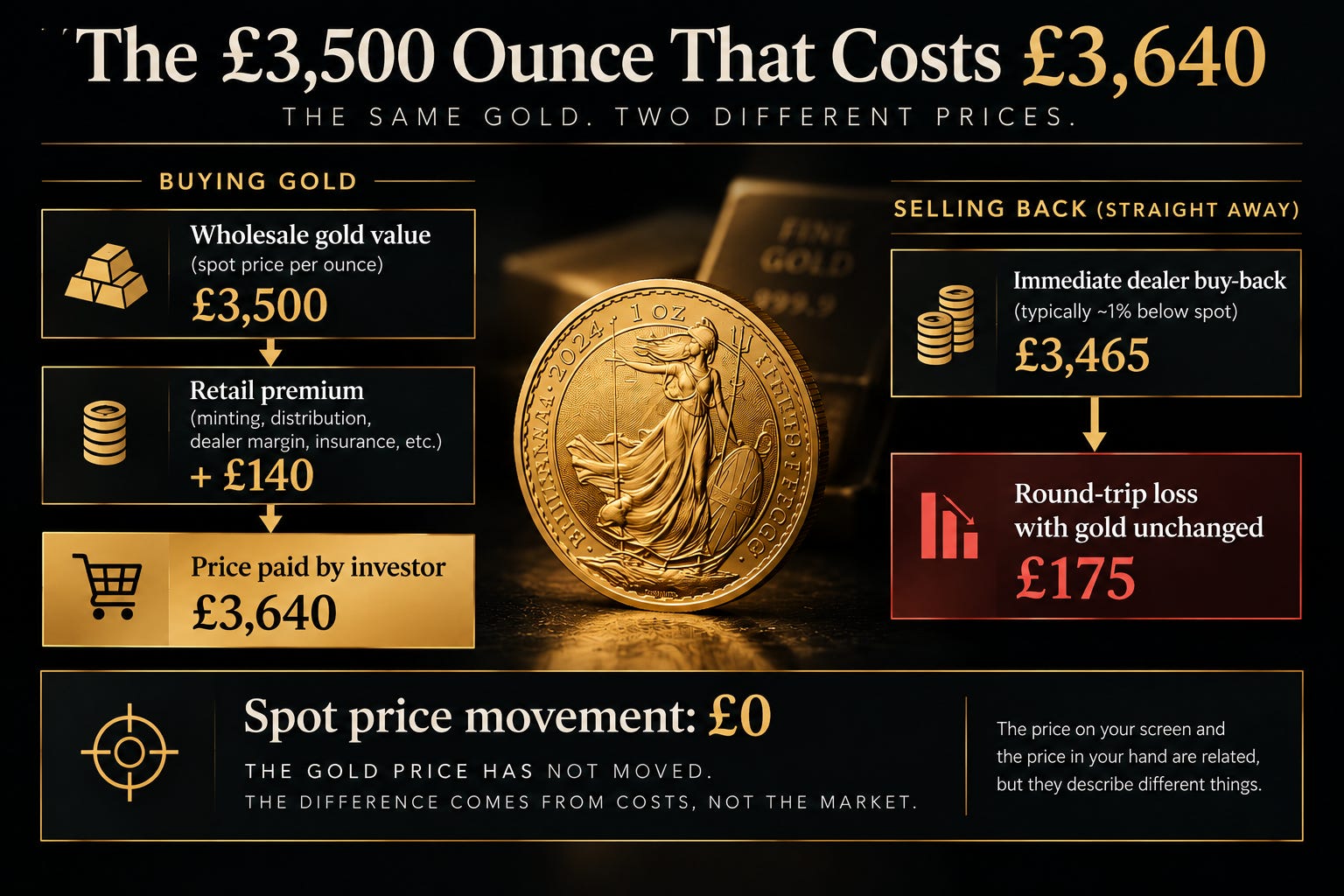
The screen price and the price of a Britannia belong to the same market, but they describe different things.
The 12-kilogram bar beneath London has not moved. Around it, almost everything else has.
Its price is being argued over by people who may never touch it. Miners produce it, refiners purify it, banks quote it, funds trade it, central banks accumulate it, COMEX traders price its future and dealers turn the wholesale market into coins and bars an investor can hold.
Nobody gets to set the gold price alone.
They merely keep bidding for the right to decide what the next ounce is worth.
If you are thinking about how to protect your wealth in this environment, you can explore physical gold and silver through www.goldwise.com, where the focus is on ownership, security and transparency.
Goldwise are committed to producing educational content that helps investors better understand the macroeconomic forces shaping financial markets. If there are topics you would like us to explore in future editions, we welcome your feedback.
Disclosure: Mr. Matthew Oliver, Oliver Market Intelligence, is a shareholder in Goldwise. Any opinions, analysis and views expressed in this publication are solely those of Mr. Matthew Oliver and Oliver Market Intelligence and are provided independently unless expressly stated otherwise.
This publication is provided for informational and educational purposes only and does not constitute financial, investment or other professional advice. References to Goldwise are for informational purposes and should not be construed as a recommendation to purchase any product or service. Investments can fall as well as rise in value, and readers should conduct their own research and, where appropriate, seek advice from a qualified financial adviser before making any financial decisions.