


Nearly twenty years ago, eight drill holes tested the ground beneath El Alto. They were relatively shallow, and the project was left without a clear picture of what lay deeper.
Now, Super Copper has returned with a different geological model, and the first results are beginning to change that picture.
Four holes. Four copper intersections. Grades reaching 2.21%, and a drill hole whose final reported sample still contained copper more than 500 metres downhole.
The significance is not simply that copper has been found. It is where the company is finding it.
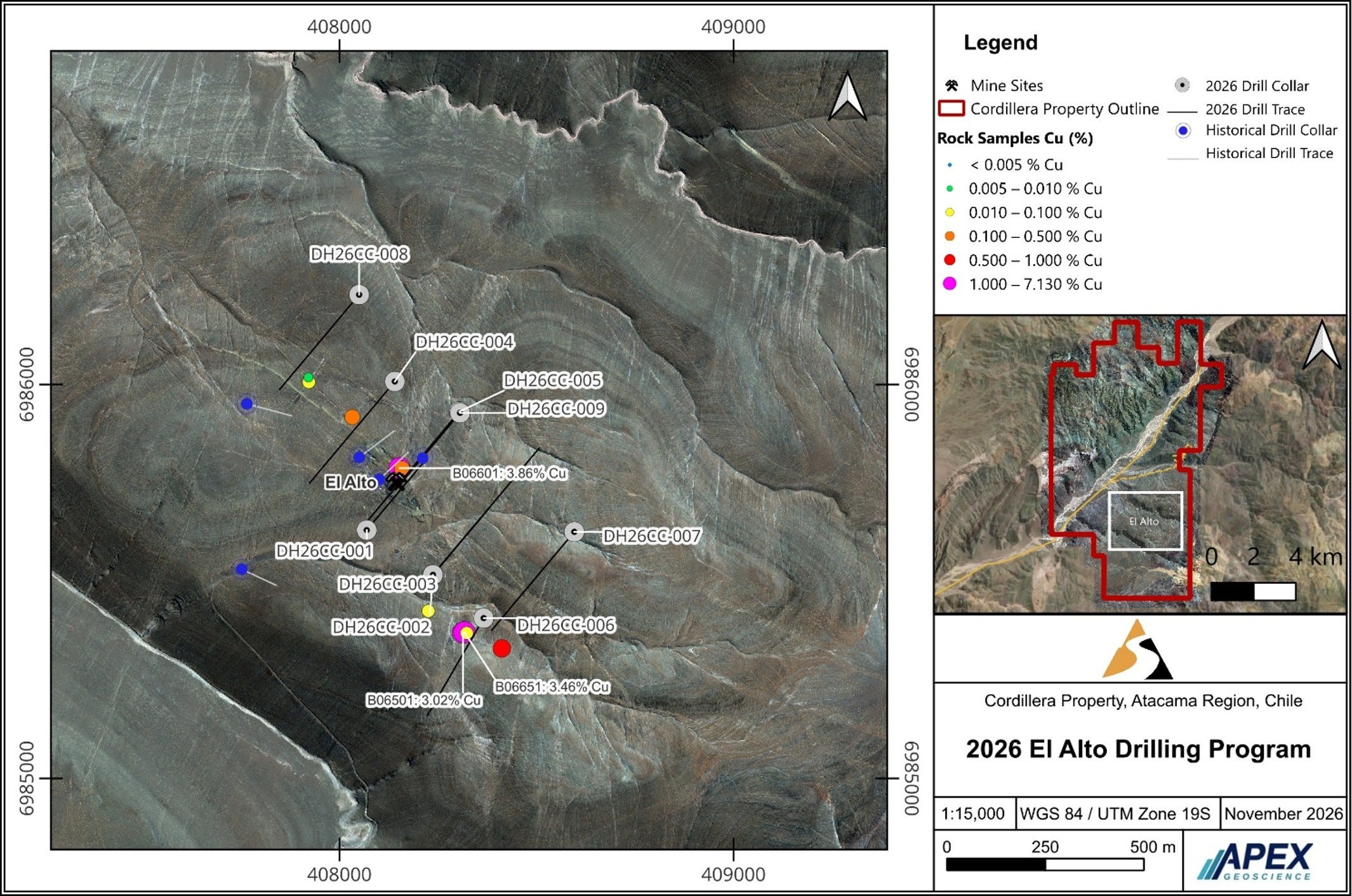
Modern geophysics had suggested that historical drilling tested the margins of a larger mineralised system. Super Copper’s maiden programme has now intersected copper at multiple depths and locations along an approximately 800-metre northwest-trending corridor.
The old drilling raised the question of what might have been missed. The new drilling is beginning to provide the evidence.
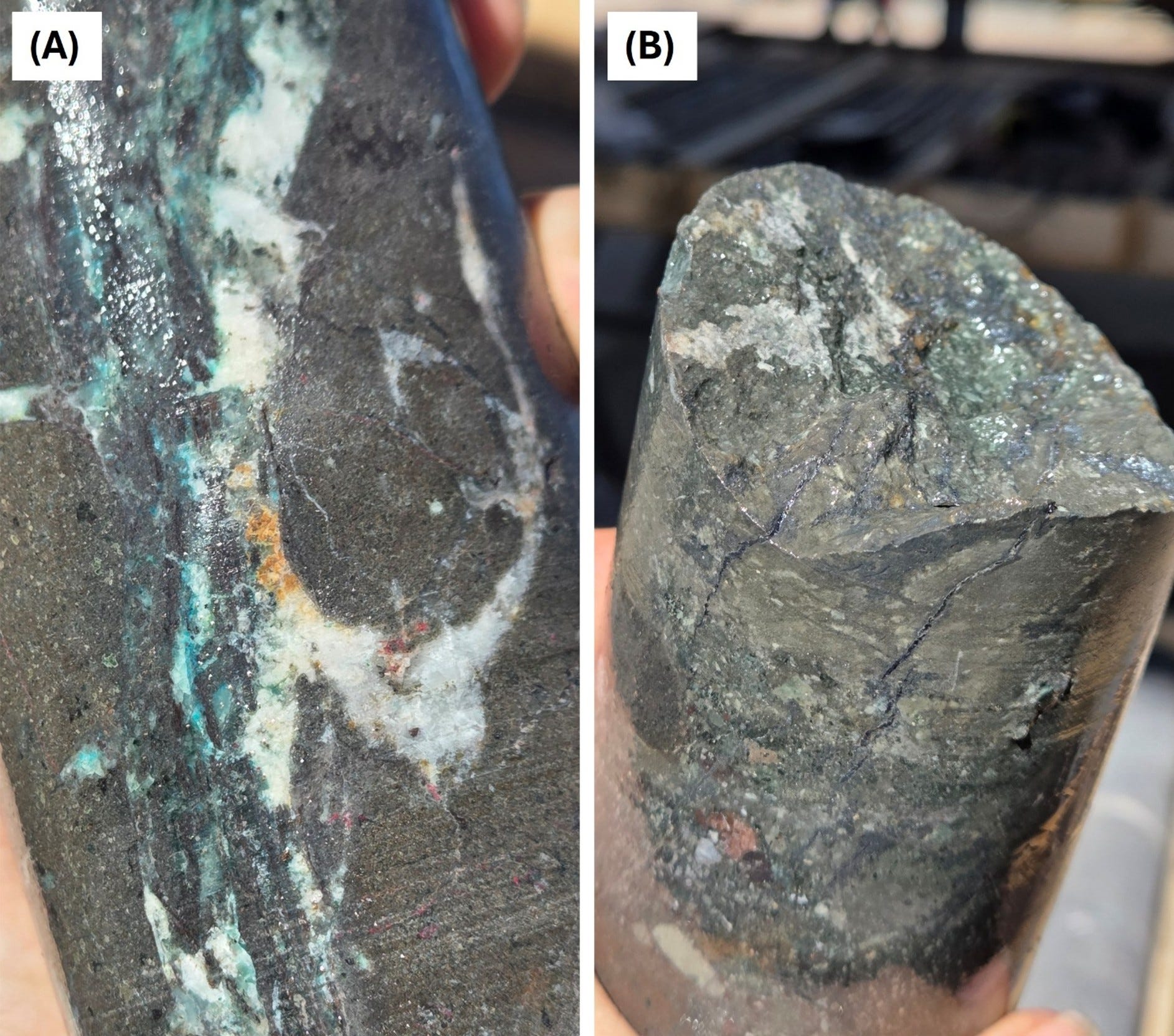
The Copper Beneath El Alto
On 10 November, Super Copper announced assay results from the first four holes of its maiden drilling programme at Cordillera Cobre, in Chile’s Atacama region.
All four intersected copper mineralisation, with the strongest results coming from two holes drilled from the same platform at different angles.
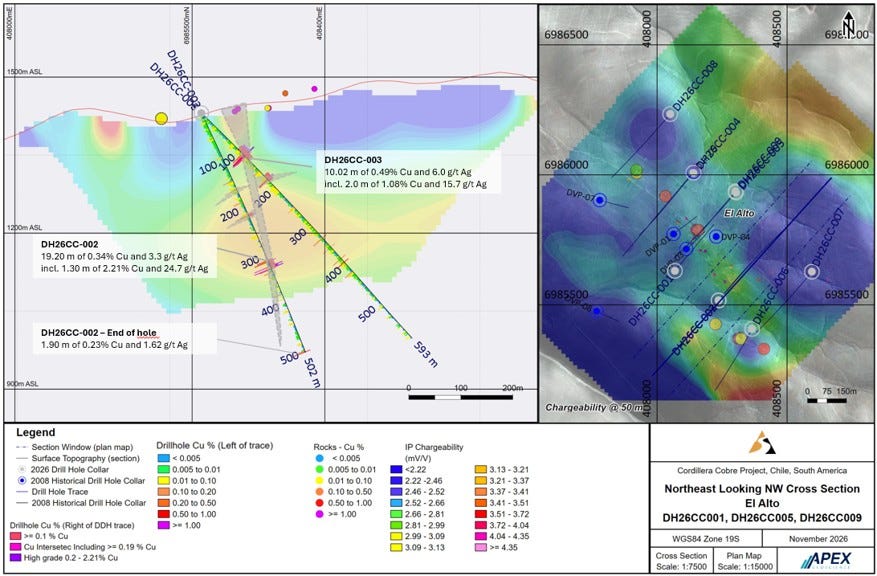
Hole DH26CC-002 intersected 19.2 metres grading 0.34% copper and 3.3 g/t silver from 310 metres, including 1.3 metres at 2.21% copper and 24.7 g/t silver.
The hole reached approximately 505 metres, with its final reported sample still carrying 0.23% copper at 501.9 metres.
The deeper extent of mineralisation therefore remains unresolved.
Hole DH26CC-003, drilled at a shallower angle, returned 10 metres at 0.49% copper and 6.0 g/t silver from 110 metres downhole, approximately 80 metres beneath surface. That interval included 2 metres at 1.08% copper and 15.7 g/t silver.
These intersections begin to establish the orientation of the mineralised structure, giving Super Copper a clearer understanding of where subsequent drilling should be directed.
They also demonstrate that higher-grade copper occurs within the broader system, although its continuity remains unproven.
What the Old Drilling Could Not See
Exploration results tend to acquire an authority they do not always deserve. Once a property has been drilled, investors instinctively regard it as tested.
But a drill hole only tests the geological idea that put it there.
The 2007 programme at El Alto consisted of eight diamond holes totalling approximately 1,555 metres, drilled before the modern induced-polarisation survey now available to Super Copper.
That survey identified a substantial chargeability response, with the strongest sections extending beneath ground that had never been tested at comparable depths.
The latest drilling has begun testing that interpretation directly.
Hole DH26CC-001, approximately 200 metres northwest along the corridor, returned 18 metres at 0.12% copper, including 4 metres at 0.26%.
Further northwest, DH26CC-004 intersected 6 metres at 0.11% copper, including a narrower interval grading 0.46%.
These are not uniformly high-grade intersections. Their importance lies in establishing copper mineralisation at several locations along the same interpreted structural trend.
Super Copper believes the mineralisation follows the axis of a folded volcanic sequence, with copper occurring in veins, breccias and fractures, alongside potentially favourable tuff horizons.
The geological characteristics suggest similarities with Chilean manto-style copper systems, although further drilling is required to establish the deposit’s nature and extent.
The distinction is important. El Alto is no longer simply a geophysical anomaly supported by historical exploration. It is now an actively drilled copper system with assay-confirmed mineralisation across multiple locations.
The Question of Scale
Super Copper had completed more than 3,850 metres of drilling at the time of its latest announcement, with copper-bearing mineralisation visually identified in all eight holes reported to date.
Assays from holes five through eight remain outstanding, while additional drilling is being directed towards extending the system along strike and at depth.
The next results will help establish whether the higher-grade intersections represent isolated concentrations or parts of a more continuous mineralised structure.
The company also intends to integrate the new assays with its geophysical interpretation, refining targets within the main corridor and surrounding copper-bearing horizons.
For an early-stage explorer, that distinction is consequential.
Finding copper establishes geological interest. Demonstrating consistent grades, meaningful widths and continuity across a substantial area is what begins to establish the potential scale of a discovery.
El Alto has not reached that point.
True widths remain undetermined, grades vary between holes, and the outstanding assays could materially alter the geological interpretation. Nor does the presence of copper establish that a deposit will ultimately prove economic.
But the evidence is now more substantial than it was before the drill programme began.
The historical holes suggested copper existed around the margins of a larger target. Modern geophysics provided a reason to investigate deeper. The first assays have now confirmed copper at multiple depths, including higher-grade intervals and mineralisation continuing to the deepest reported sample.
Nearly twenty years after the original exploration programme, Super Copper has moved beyond asking whether El Alto contains copper.
The question now is whether the next holes can establish the continuity, grade and scale needed to turn those first intersections into something considerably more significant.
Disclosure: This article has been commissioned by Super Copper Corp (CSE: CUPR). The views expressed are that of Matt Oliver, Oliver Mining Network and reflect his own analysis. This article is provided for informational purposes only and does not constitute financial or investment advice. Investments are inherently speculative and involve risk, including the loss of capital.