


In 1948, the Geological Survey of Canada recorded anomalous radioactivity around Don Lake, a remote stretch of northern Saskatchewan near Lake Athabasca. The discovery arrived at an extraordinary moment. Only three years had passed since the atomic bomb demonstrated uranium’s destructive potential, and governments were beginning to recognise that control over the metal would carry strategic consequences far beyond the mining industry.
Prospectors followed the discoveries north. Mines opened, infrastructure appeared and Uranium City developed around the expanding Beaverlodge uranium district. Between 1950 and 1982, the district produced approximately 70 million pounds of uranium oxide, becoming one of Canada’s earliest centres of commercial uranium production.
Then the industry moved on. Mines closed, exploration spending diminished and the geological records accumulated in government archives. The radioactive rocks remained where they had always been, but the capital required to investigate them had largely disappeared.
Nearly eighty years later, Eagle Plains Resources has returned to Don Lake. Alongside its exploration partner, Xcite Uranium, the company is examining historical uranium occurrences with modern drilling and geophysical techniques, looking for evidence that earlier generations may have left behind something commercially significant.
The renewed activity comes from a company whose own history is unusually long by junior mining standards.
Surviving the Exploration Business
Junior mining has a peculiar relationship with time. A promising geological theory can survive for decades, while the company financing it may struggle to survive a few unsuccessful drilling campaigns. Discoveries require patience, but shareholders, financing conditions and commodity markets rarely operate on geological timescales.
Eagle Plains has spent more than thirty years working around that contradiction.
Established in 1992 and headquartered in Cranbrook, British Columbia, the company is the fourth-oldest listed issuer on the TSX Venture Exchange. Remarkably, it has never consolidated its shares, avoiding a practice that has become almost routine among exploration companies attempting to repair capital structures weakened by repeated equity financing.
Its business model helps explain that longevity. Rather than committing most of its capital to developing one deposit, Eagle Plains acquires prospective mineral properties, undertakes preliminary geological work and brings in partners to finance more expensive exploration. In return, those partners can earn ownership interests through drilling expenditures, cash payments and share issuances.
The company holds more than 50 projects across western Canada, covering commodities including uranium, gold, copper and silver. Eagle Plains currently has 15 projects under option, representing approximately C$39.95 million in potential exploration expenditures under the respective agreements. These are contractual commitments subject to the relevant agreements, rather than expenditure already incurred.
There is also an operating business beneath the exploration portfolio. TerraLogic Exploration, its wholly owned geological contracting subsidiary, provides technical services to the mining industry and generates revenue independently of mineral discoveries.
TerraLogic generated approximately C$12.5 million in revenue during the first half of 2026, compared with C$3.6 million during the corresponding period a year earlier. The subsidiary has typically contributed between C$1 million and C$2 million annually to Eagle Plains, providing an additional source of capital for the company's exploration activities.
The company also held approximately C$7.5 million in cash and more than C$4 million in marketable securities as of its June 2026 financials. These holdings provide capital for early-stage exploration without requiring a reliance on new equity financing.
Corporate transactions have provided another means of realising value. Previous spin-outs include Copper Canyon Resources, acquired in a transaction valued at approximately C$65 million, and Taiga Gold, acquired for around C$31 million. Management attributes more than C$115 million in historical shareholder value to its spin-out strategy.
The trade-off is ownership. By allowing partners to finance exploration, Eagle Plains surrenders a substantial portion of the economic interest in projects that may eventually become valuable. But financing every programme independently carries its own cost, particularly when repeated equity raises dilute existing shareholders.
The result is a business model that retains smaller interests across a wider portfolio while directing its own capital towards selected exploration opportunities.
What the Prospectors Found at Don Lake
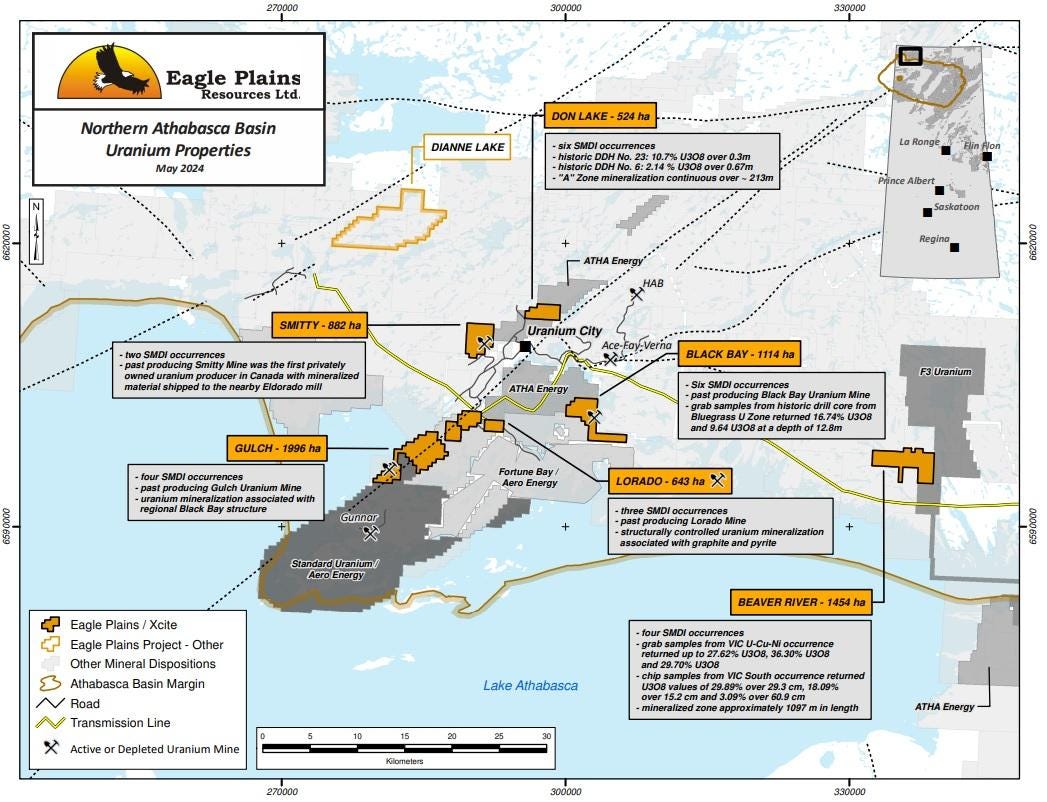
Don Lake sits within the historic Beaverlodge uranium district near Uranium City. The 1,671-hectare property contains twelve documented uranium occurrences, including the historical Don Lake deposit and the past-producing Beta Gamma mine.
Historical drilling at the A Zone returned 10.7% uranium oxide (U₃O₈) over 0.3 metres and 2.14% over 0.67 metres. Trenching produced results reaching 8.57% over 0.91 metres, while exploration across the A, B and C zones identified uranium mineralisation extending along approximately 525 metres of strike.
Those grades explain why geologists keep returning to the property. They also expose the difficulty that has frustrated exploration across countless mineral districts: impressive uranium concentrations over narrow intervals, without sufficient drilling to establish what lies between them.
A 10.7% uranium intercept attracts attention. A commercially viable deposit requires something considerably harder to establish.
Much of the historical work was shallow, documentation was incomplete and the earlier results have not been independently verified under modern reporting standards. The original explorers established the presence of uranium, but the scale and continuity of the mineralised structures remained uncertain.
The geology presents its own difficulties. Uranium at Don Lake occurs principally within fractures, veins and shear zones, where mineral-bearing fluids moved through ancient basement rocks. These structures can contain exceptionally rich mineralisation over relatively small widths, while nearby drilling encounters considerably weaker concentrations or none at all.
The nearby Black Bay Fault forms part of the geological setting that influenced uranium mineralisation throughout the Beaverlodge district. Understanding how smaller fractures and mineralised structures intersect these larger faults is central to the current exploration programme.
The earlier prospectors had identified uranium at the surface and encountered it underground. What they lacked was sufficient information to establish whether those occurrences belonged to a larger, continuous system.
Eagle Plains and Xcite are now attempting to answer that question with more sophisticated geological information and modern drilling techniques.
The New Drilling Evidence
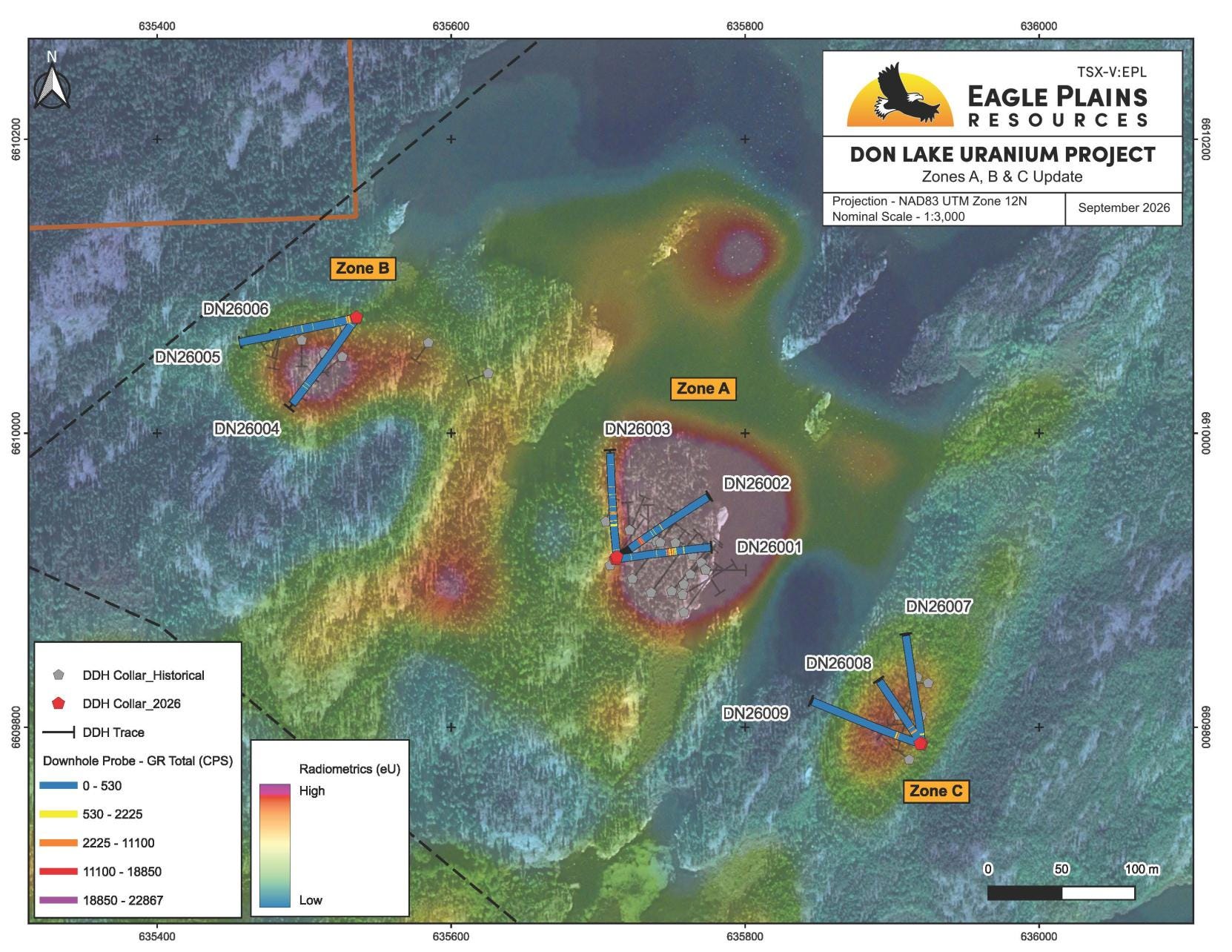
The 2026 programme at Don Lake involved ten drill holes totalling 1,106 metres, testing uranium mineralisation associated with the historical A, B and C zones.
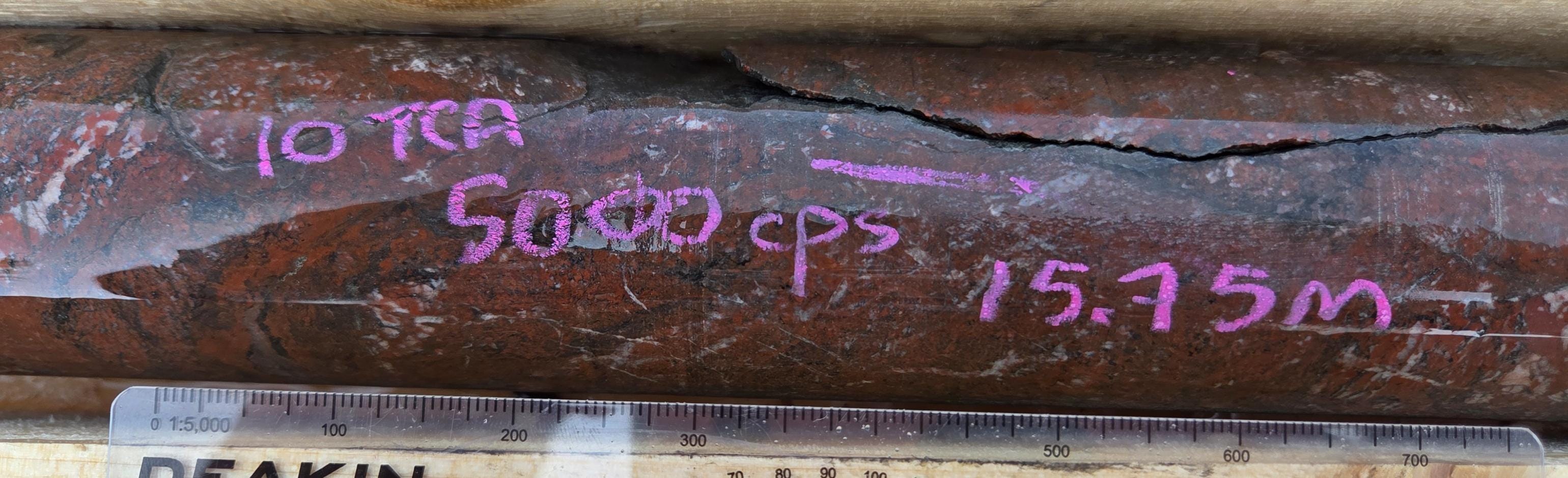
Results released in August and September identified several intervals of anomalous radioactivity. Hole DN26001 returned 1.9 metres averaging 11,571 counts per second, while DN26009 encountered 2.2 metres averaging 4,517 counts per second. Another hole, DN26006, intersected a broader 5.5-metre interval averaging 2,656 counts per second.
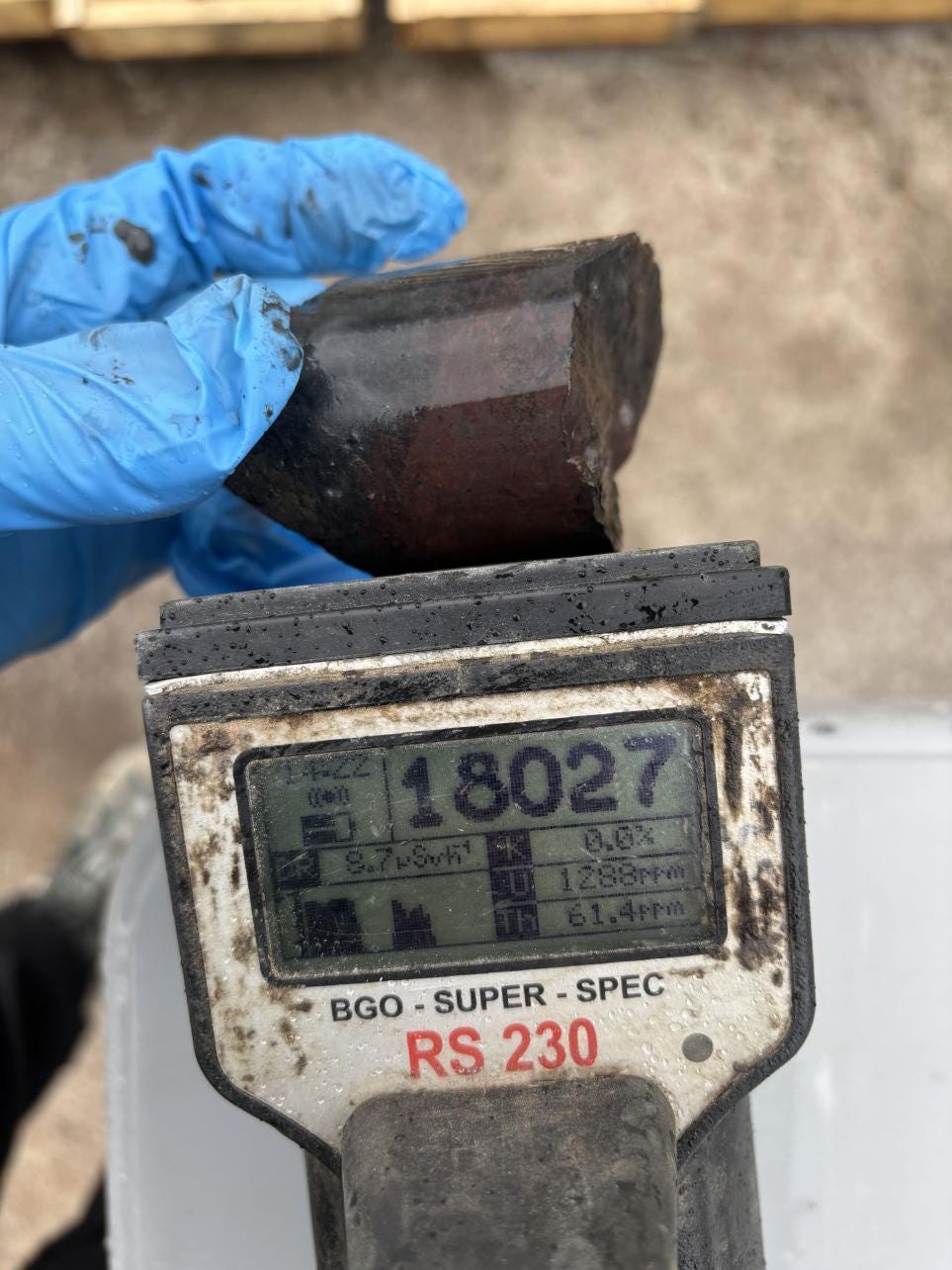
A peak hand-held scintillometer reading of 51,978 counts per second was also recorded from DN26001, although laboratory assays are required to establish the corresponding uranium grade.
These measurements record gamma radiation rather than uranium concentration. Elevated radioactivity can indicate uranium mineralisation, but laboratory assays are required to determine actual grades. Narrow, high-grade structures can produce strong radioactive readings without necessarily demonstrating economic continuity.
Three of the ten holes returned no significant anomalous radioactivity. Such variation is consistent with the difficulty of exploring structurally controlled mineralisation, where relatively small differences in drill positioning can produce markedly different results.
The drilling identified radioactivity associated with altered gabbroic gneiss containing silica, feldspar, hematite and chlorite alteration. These features provide clues about the geological structures through which uranium-bearing fluids travelled and may help refine future drill targets.
The depth of the new intersections is particularly relevant. At Zone A, historical drilling in 1969 generally reached only 20 to 34 metres, leaving much of the underlying structure untested. The 2026 programme encountered elevated radioactivity beneath those earlier intersections, suggesting that uranium-bearing structures may extend beyond the shallow levels investigated by previous operators.
The results have raised the possibility that the mineralised structures extend at depth and may connect across the three historical zones. Establishing whether they form part of a continuous system will require further drilling, while laboratory assays are needed to determine the uranium grades associated with the radiometric readings.
That interpretation remains preliminary. Laboratory assays are required to establish uranium grades, while additional drilling would be necessary to demonstrate continuity between the zones.
The approximately C$1.1 million Don Lake programme represents an attempt to connect historical observations with modern subsurface information. The outstanding assays, together with the structural information obtained from drilling, will help determine which targets warrant further investigation.
The Next Test for Uranium City
The return to Don Lake has produced encouraging radiometric evidence, but not yet the laboratory results required to establish uranium grades. The 2026 drilling encountered elevated radioactivity beneath historical workings, raising the possibility that mineralised structures extend beyond the shallow levels investigated by earlier generations.
Whether those structures connect across the property remains unresolved.
The immediate test will come from laboratory assays. These will establish the uranium grades corresponding to the radiometric readings and help determine whether the latest intersections warrant further drilling. The results will also inform geological interpretations of the relationship between the A, B and C zones.
Beyond Don Lake, the wider Uranium City programme offers several potential catalysts. Further drilling at Lorado, Gulch and Black Bay could provide additional information about the district’s mineralised structures, while previously untested targets identified through modern geophysics and geochemistry offer opportunities for exploration beyond the historical workings.
The scale of Xcite’s prospective 2027 programme will also be worth watching. If the company proceeds with its planned earn-in timetable, further exploration expenditure could support a considerably broader campaign across the six properties. The timing and scope of that work will depend on funding, results and the approaching seasonal drilling windows.
The structure of that partnership is central to the opportunity. Across the six Uranium City properties, which together host 54 documented uranium occurrences and five historical mines, Xcite can earn an 80% interest by completing up to C$19.2 million in exploration expenditures, alongside cash and share payments to Eagle Plains. Following a completed earn-in, Eagle Plains would retain a 20% joint venture interest in each property, carried through to the delivery of a bankable feasibility study, together with a 2% net smelter return royalty. The exploration expenditure, and the study-stage funding that would follow any discovery, therefore falls to the partner rather than to Eagle Plains shareholders.
Eagle Plains has additional exploration opportunities beyond uranium. At George Lake in Saskatchewan, the company completed three drill holes during 2026, testing extensions of a historical zinc deposit containing approximately seven million tonnes grading around 4% zinc. That figure is a historical estimate that has not been verified by a qualified person and should not be treated as a current mineral resource. Management reported mineralisation extending as much as 260 metres below historical drilling and identified further exploration as a priority for 2027.
At the Theory copper-gold project in British Columbia’s Toodoggone district, partner Sun Summit Minerals completed its 2026 field programme. The option agreement provides for further exploration commitments, including drilling, subject to the relevant terms and partner decisions.
None of these programmes guarantees a commercial discovery. Historical uranium grades and elevated radiometric readings cannot establish a viable deposit, while future exploration remains dependent on funding, geological results and the decisions of operating partners.
But the position today is different from the decades when Uranium City’s geological records attracted little investment. Multiple properties are again being investigated, modern exploration methods are testing old interpretations, and substantial partner-funded expenditure may follow.
Nearly eighty years after uranium was first identified at Don Lake, Eagle Plains is no longer relying solely on the district’s history to make its case. The next assays and drilling programmes will begin to establish whether the mineralisation encountered beneath the old workings belongs to something larger.
Disclosure: This article has been commissioned by Eagle Plains Resources (TSXV: EPL). The views expressed are that of Matt Oliver, Oliver Mining Network and reflect his own analysis. This article is provided for informational purposes only and does not constitute financial or investment advice. Investments are inherently speculative and involve risk, including the loss of capital.
Don Lake sitting quiet in the government files from 1948 until Eagle Plains and Xcite went back with modern drilling is a long pause, even by uranium standards, after the Beaverlodge district put out about 70 million pounds of uranium oxide between 1950 and 1982. Historical hits such as 10.7 percent U3O8 over 0.3 metres at the A Zone, and 8.57 percent over 0.91 metres in trenches, explain the return, while the warning that those rich intervals are narrow and never verified to current standards keeps the story honest. The 2026 program of ten holes for 1,106 metres, with DN26001 averaging 11,571 counts per second over 1.9 metres and a handheld peak of 51,978, is encouraging radiometry rather than a grade, which the piece is careful to separate. Three holes with no significant reading, and the older 1969 work stopping around 20 to 34 metres, make the deeper radioactivity under Zone A the detail that actually moves the geology. Eagle Plains lasting since 1992 without a share consolidation, holding more than 50 projects and about C$39.95 million of possible partner spend across 15 optioned properties, plus TerraLogic's C$12.5 million of revenue in the first half of 2026, shows how a junior can keep drilling without betting the company on one hole. Company-backed drilling write-ups of that sort, read from an iron-ore coast in Western Australia, can be found through my profile.
All my articles: https://lukeybkarratha.substack.com/archive