


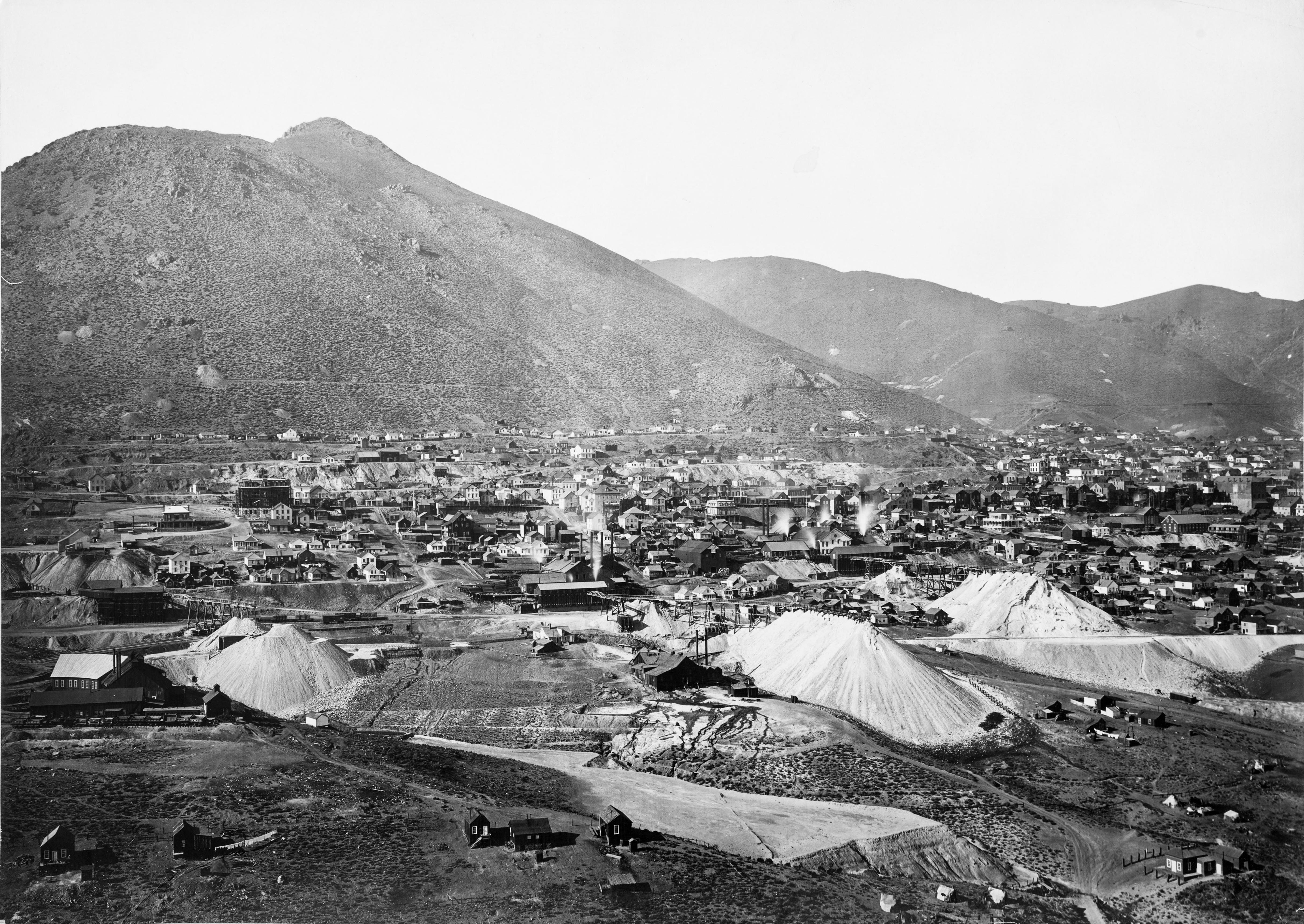
In 1859, prospectors working around Virginia City, Nevada discovered something irritating beneath their gold. A heavy blue-black mud clogged their equipment and made processing difficult. Miners cursed it, discarded it and complained about the nuisance. Eventually someone had it assayed. The worthless mud contained extraordinarily rich silver ore.
It became the Comstock Lode.
Fortunes were made, the heavy blue-black mud led to the discovery of the Comstock lode, and Nevada went from remote desert to to become one of the great mining centres of the nineteenth century. The episode captured a recurring feature of commodity markets. What investors consider valuable depends heavily on what they have been conditioned to look for.
More than 160 years later, Nevada’s geology has not changed, but the perception of its mineral value has transformed significantly as Navada, USA became the fifth largest gold providing entity in the world.
Gold has spent the past several years escaping the psychological box in which Western investors placed it during the era of cheap money. Central banks have accumulated bullion, governments have continued borrowing, currencies have been diluted and the metal has moved from an unfashionable portfolio hedge towards a strategic reserve asset once again.
Integra Resources sits one layer beneath that trade. It does not own gold in a vault. It owns the harder proposition: mines, development projects and ounces still held in the ground.
Integra is a wager on whether gold’s repricing eventually reaching the companies still extracting it.
The Strange Economics of a Gold Mine
Gold equities are intended to provide leverage to gold. The logic looks simple on paper. A mine sells ounces at the prevailing gold price while much of its cost base does not rise dollar-for-dollar with bullion. Once the gold price moves sufficiently above the cost of producing an ounce, additional revenue can fall disproportionately towards cash flow.
Mining companies have spent decades finding inventive ways to dilute that leverage through cost inflation, weak acquisitions, overruns, falling grades and shareholder dilution. A rising gold price can conceal bad management for surprisingly long periods. This explains why seasoned precious-metals investors often treat a beautiful investor presentation with roughly the same suspicion they reserve for a government inflation forecast.
So ounces in the ground are not enough.
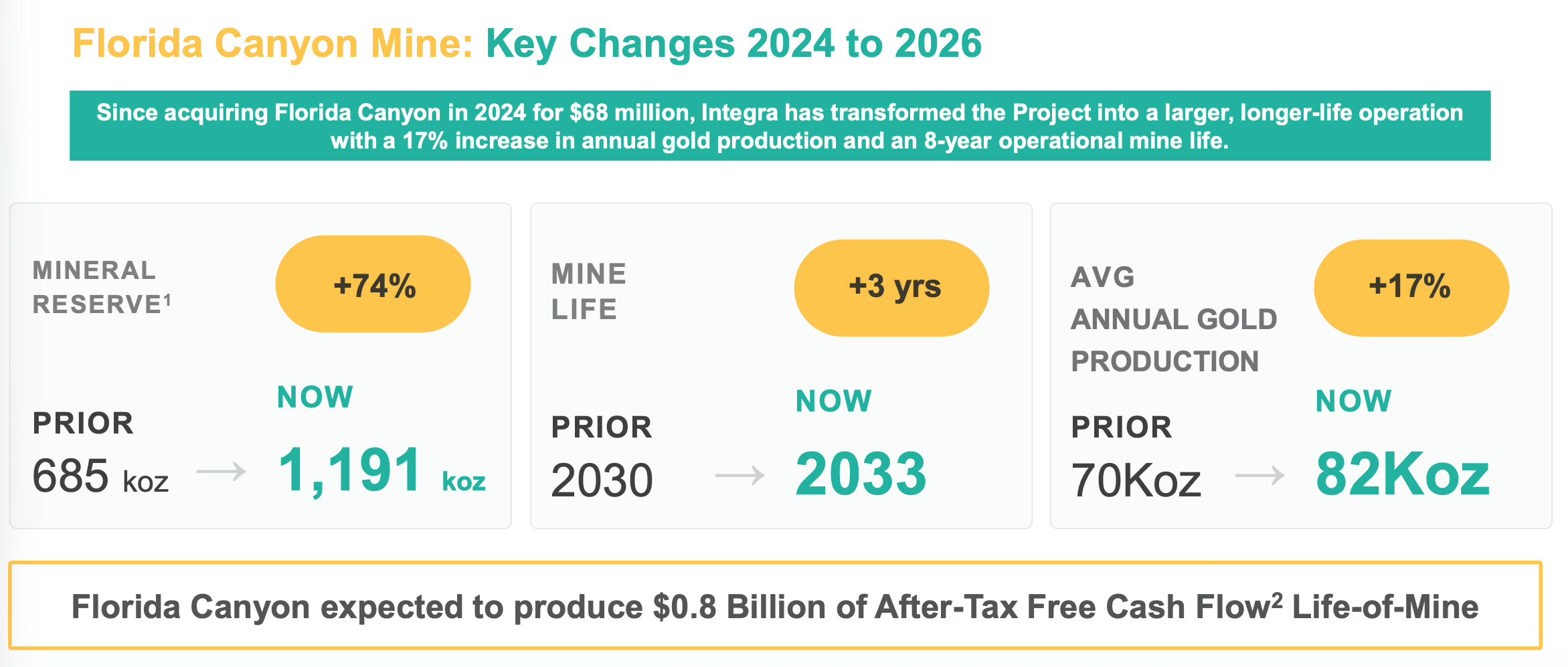
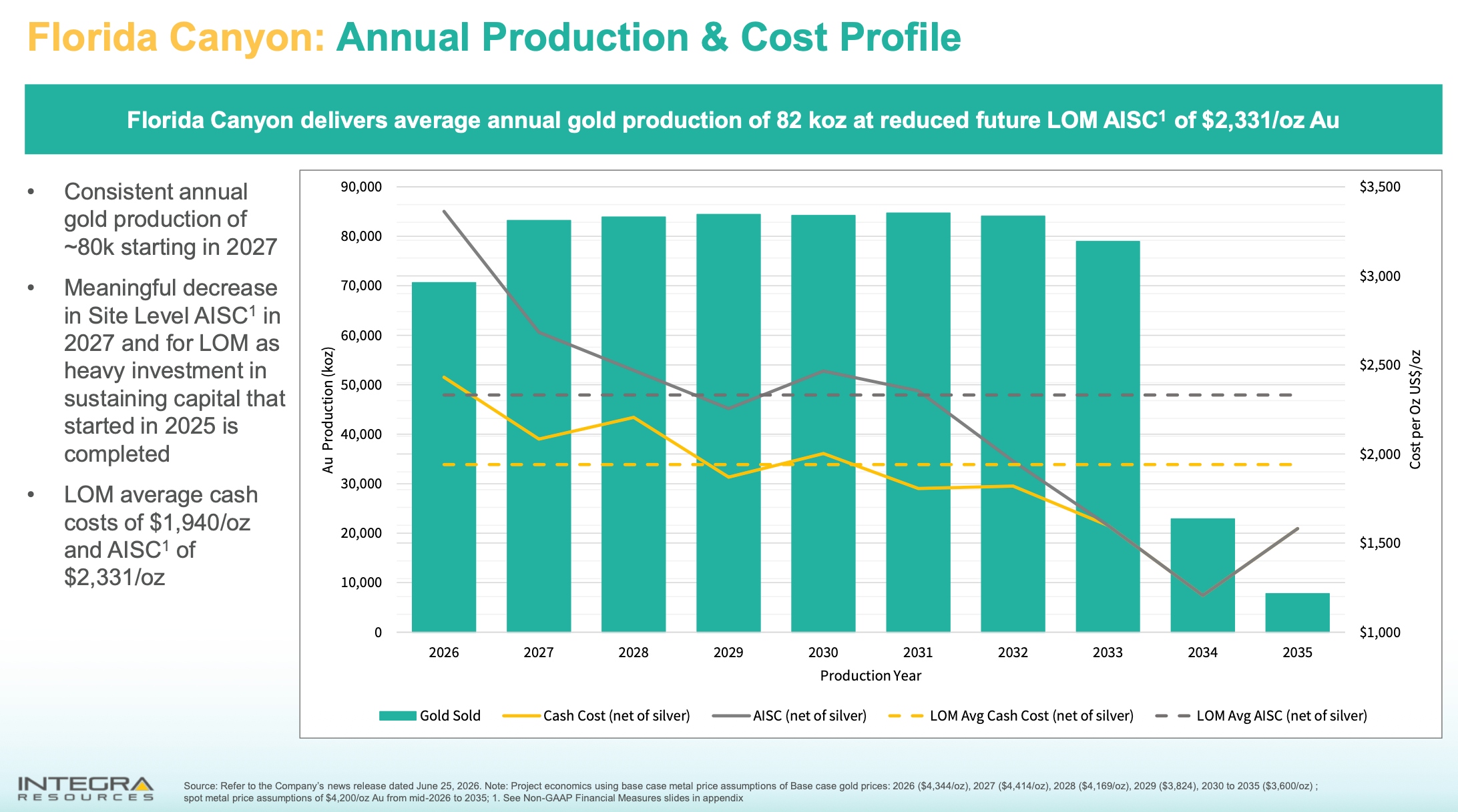
Intera’s fortunes changed materially when it combined with Florida Canyon Gold in 2025. Integra ceased being primarily a developer and became a producer, with Florida Canyon in Nevada providing operating cash flow while DeLamar in Idaho and Nevada North offered development optionality beyond Florida Canyon.
Development-stage miners live at the mercy of capital markets. Engineering studies may assign impressive values to projects, but mines consume cash for years before producing it. Financing becomes particularly painful when sentiment turns and equity prices fall. Existing shareholders frequently discover that the gold was always there; their ownership of it was the variable.
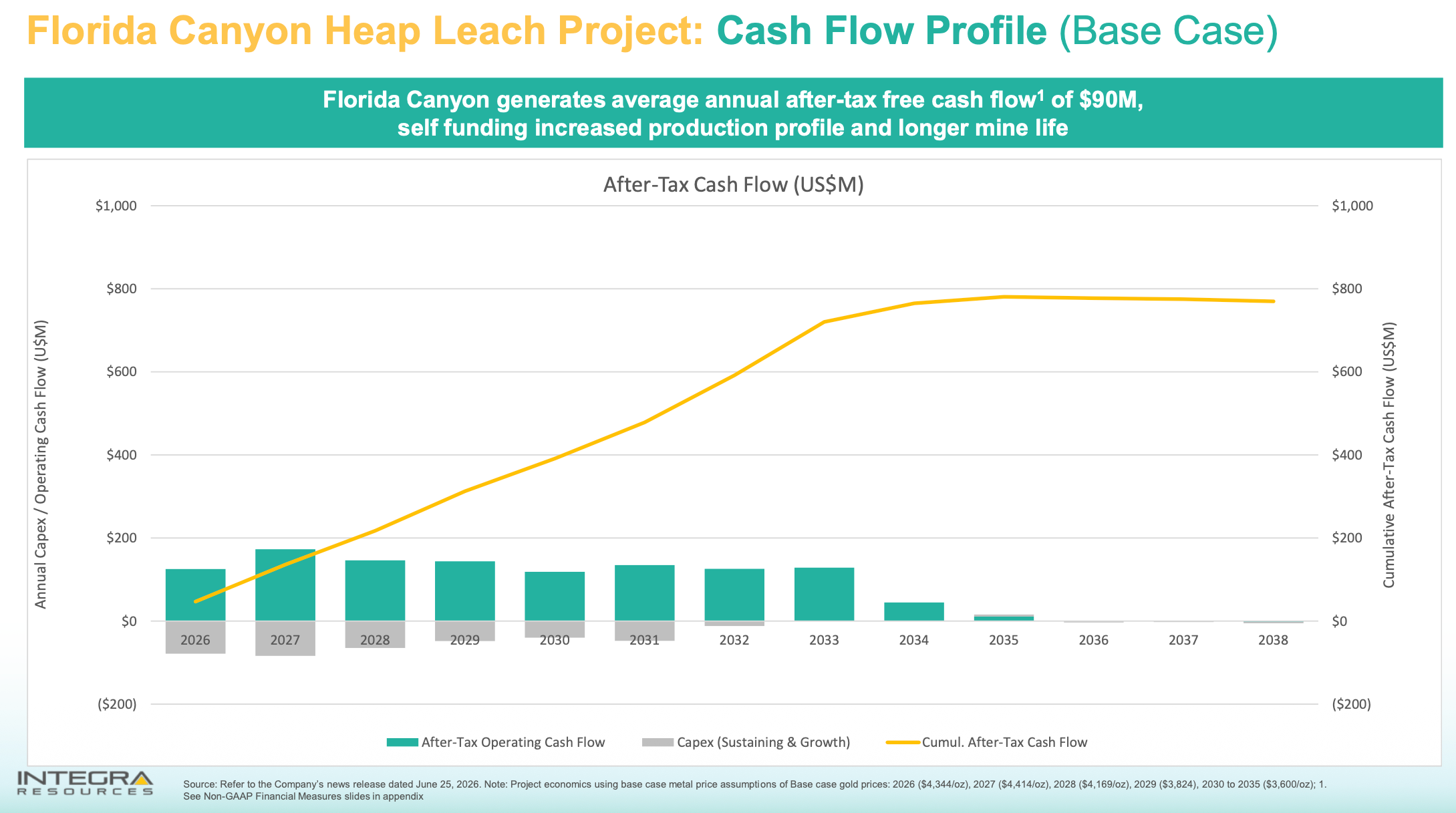
Production breaks that dependency. Cash generated today can help fund the ounces intended for tomorrow.
Florida Canyon Makes the Story Real
Florida Canyon is not more than a bridge to some distant development story. It gives Integra exposure to Nevada, one of the world’s established gold jurisdictions, with infrastructure and decades of mining knowledge already embedded in the region.
Production also gives investors something development projects have yet to provide: evidence.
Tonnes must actually be moved. Recoveries have to work beyond a spreadsheet. Costs appear in financial statements rather than engineering assumptions.
High gold prices can make mediocre deposits appear exceptional. The question is not whether a company can make money with gold trading at extraordinary levels. Almost any functioning producer should look better under those conditions. What matters most is what management does with the windfall.
Cash will strengthen the balance sheet. It can support Florida Canyon and it can advance DeLamar, and can reduce dependence on future equity issuance. Used intelligently, each dollar generated by the producing mine increases the probability that shareholders retain more of the value embedded in the development portfolio.
Drill-core photographs matter less than cash flow.
DeLamar Is Where the Scale Appears
Drive north-east from Nevada into Idaho and the financial problem becomes much larger. DeLamar is not simply another satellite deposit feeding an existing operation. It is the asset that could turn Integra from a small producer into something significantly and materially larger.
The project contains a substantial gold and silver resource within a historic mining district. Its attraction is scale, but scale in mining comes with an uncomfortable companion: capital.
A large undeveloped resource can create enormous theoretical value while simultaneously becoming a financing problem. The larger the mine, the more infrastructure, equipment and upfront expenditure required before the first commercial ounce appears. A project’s net present value may look compelling at higher metal prices while still leaving shareholders exposed to permitting delays, construction inflation and expensive funding.
Florida Canyon provides production. DeLamar provides scale. Nevada North provides an additional source of longer-dated optionality. The result is a pipeline rather than a single binary bet.
But investors should resist assigning full value simultaneously to every future ounce . Mining history is littered with resources that looked magnificent in technical reports and considerably less impressive once capital had to be raised and rock had to be processed.
An ounce in a resource estimate is not the same thing as an ounce poured into a doré bar.
Markets discount undeveloped ounces because history tells them to.
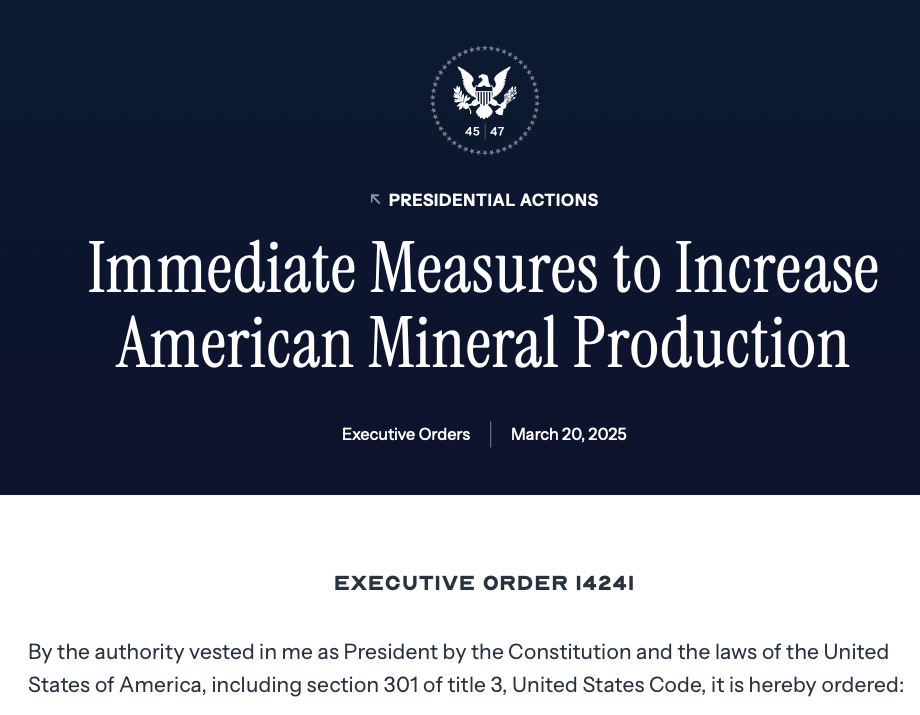
Washington Has Rediscovered the Mine
American mining now carries a political significance it barely had during the previous commodity cycle.
For years, Western governments behaved as though the physical origin of commodities was largely irrelevant. If mines were difficult to permit domestically, metals could be purchased elsewhere.
That assumption has weakened. Supply chains became strategic vulnerabilities, China demonstrated the geopolitical power attached to mineral processing and Washington began reconsidering the difference between commodities being available globally and being available securely.
Gold is different from copper, antimony or rare earths, but central banks are increasingly treating it as a reserve asset outside another country’s liability structure.
For Integra, the timing is fortunate. Its assets sit inside the United States just as domestic resource development has returned to the political and national-security conversation.
The Ounces the Market Hasn’t Seen Yet
Nevada North brings in the most seductive part of mining investing: exploration.
Drilling can change a company’s valuation faster than almost anything else in the sector because a successful hole alters expectations about an entire deposit. A few metres of mineralisation are extrapolated through geology, modelling and investor imagination into thousands or millions of potential ounces.
Sometimes the imagination is justified.
Further drilling could expand resources before investors have fully valued what Integra’s resource base holds..
Yet exploration results should be read with a critical eye. High-grade intercepts make excellent headlines, but width, depth, metallurgy and geological continuity determine whether those intercepts eventually become economic tonnes. A spectacular drill hole is evidence, not a mine.
Nevada North matters because successful drilling would be additive rather than existential. Integra no longer needs every drill programme to rescue the corporate story. That provides exploration optionality rather than existential necessity.
The Discount Exists for a Reason
Commodity bull markets encourage dangerous arithmetic: multiply the resource by the spot price and stare at the answer.
Nobody buys the gold underground at spot.
It has to be permitted, financed, mined, crushed, processed and recovered. Employees must be paid. Diesel must be bought. Equipment wears out. Waste rock has to be moved before ore can sometimes be reached. Governments take royalties and taxes. Environmental liabilities survive long after promotional presentations disappear from investor websites.
Integra is no longer a speculative explorer, but it has not earned the certainty afforded to a mature producer either.
It embodies the vagaries of transition.
If Florida Canyon generates dependable cash while management advances DeLamar without overly dilutive financing and drilling continues to strengthen Nevada North, Integra begins to look like a different company. The market stops asking how Integra will fund its ambitions and starts asking what those ambitions are worth.
Back to the Nevada Desert
The most interesting commodity investments rarely begin when everyone agrees the asset is valuable. By then the price usually reflects the discovery.
They appear when the commodity has already been repriced but the assets producing it have not.
Gold itself no longer lacks recognition. Governments are accumulating it. Investors are discussing monetary debasement again. Bullion has already forced its way back into serious macro conversation.
What should investors pay for the companies capable of producing more of it?
Integra compresses that question into three assets. There is an operating mine providing evidence today, a large development asset that could determine tomorrow’s scale and exploration capable of changing what the company owns. All of it sits within the United States and the political attitude towards domestic resources is being rewritten.
Back in 1859, Nevada’s miners threw away the dark material clogging their equipment because they understood the value of gold but had not yet understood what else they were holding.
Integra presents investors with a modern version of that question.
The value of gold is no longer being overlooked. The question is how much of that value the market is willing to assign to the companies capable of producing it.
Disclosure: This article has been commissioned by Integra Resources (NYSE: ITRG). The views expressed are that of Matt Oliver, Oliver Mining Network and reflect his own analysis. This article is provided for informational purposes only and does not constitute financial or investment advice. Investments are inherently speculative and involve risk, including the loss of capital.