


In 1898, the Homestake Mine in South Dakota was already a substantial gold producer. Its owners had spent more than two decades extracting ore from the Black Hills, building mills, shafts and the infrastructure required to operate far from the established industrial centres of the eastern United States.
Yet the mine’s eventual scale was still largely unknown.
Homestake continued operating for another century, producing roughly 40 million ounces of gold before closing in 2002. Its longevity owed much to the ability to keep investigating the deposit while mining it. Revenue from existing workings helped finance the search for the next sections of ore.
That is the position Cerrado Gold is attempting to establish at Minera Don Nicolás in Argentina.
After a difficult period for the operation, production has recovered through 2026. The improvement has given Cerrado more financial capacity to investigate the deposits surrounding its existing infrastructure, particularly the underground potential that has received relatively limited attention.
On 13 November, Cerrado added another mine to that equation, acquiring the past-producing Manantial Espejo operation from Pan American Silver. The acquisition gives the company a second potential production centre in Argentina, with an existing mill and a planned restart in 2027.
Cerrado must now establish how much longer Minera Don Nicolás can operate, while determining whether Manantial Espejo can return to production and add to the cash generated by its Argentine business.
The Recovery at Minera Don Nicolás
Minera Don Nicolás sits in Argentina’s Deseado Massif, a geological province in southern Patagonia that hosts several significant gold and silver deposits.
Cerrado controls approximately 330,000 hectares of mineral rights across the district. Its existing operation combines conventional processing through a carbon-in-leach plant with heap-leach treatment of lower-grade material.
Production has improved steadily this year.
The company reported 12,842 gold-equivalent ounces in the first quarter of 2026, followed by 15,415 ounces in the second and 16,685 ounces in the third. Third-quarter production was 21% higher than the equivalent period in 2025.
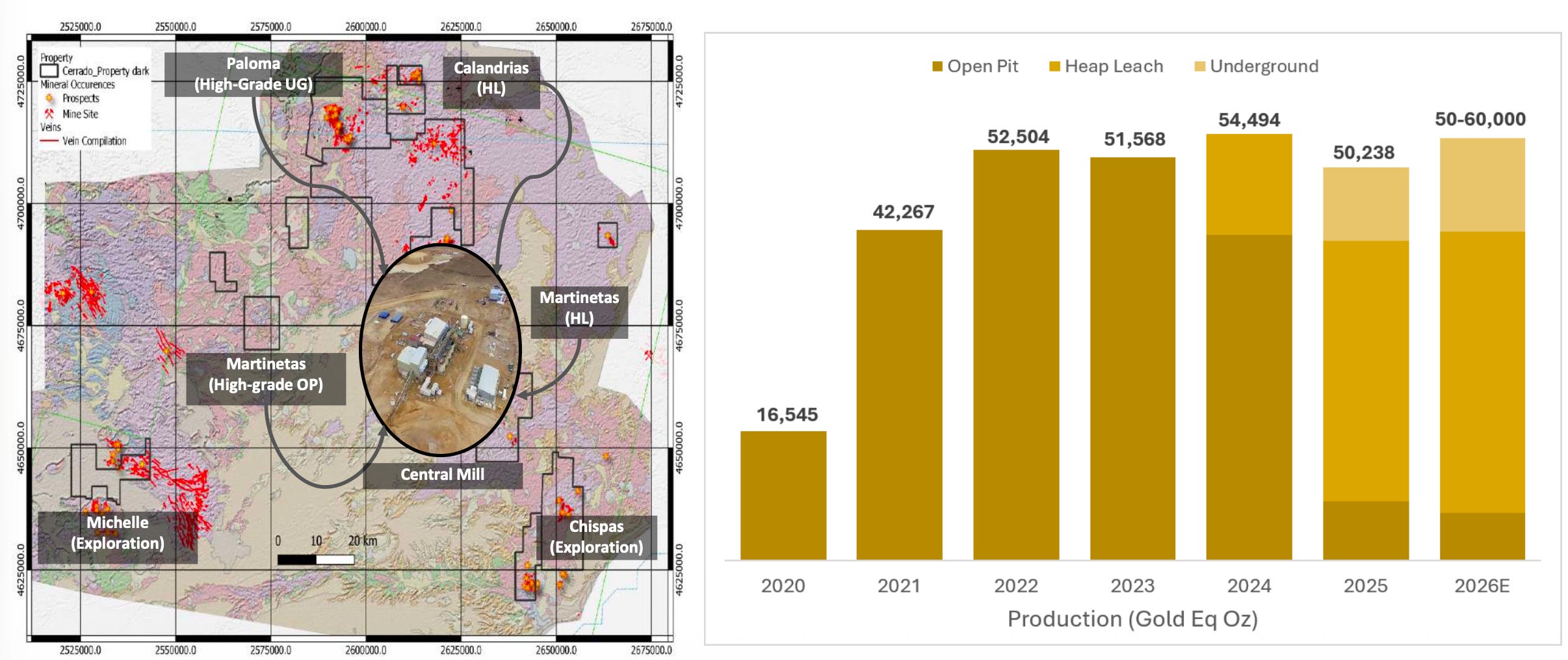
Cerrado entered the year with production guidance of 50,000 to 60,000 gold-equivalent ounces. Following the third-quarter results, management indicated that output was tracking towards the upper end of that range.
The improvement has come partly from changes in how the operation processes different grades of ore.
During the third quarter, the heap-leach operation produced 9,649 gold-equivalent ounces, while the carbon-in-leach circuit contributed 7,036 ounces.
Higher-grade material from Calandrias has increasingly been directed towards the carbon-in-leach plant. Laboratory testing on selected material has indicated recoveries approaching 95%, compared with approximately 60% under heap-leach conditions.
Those laboratory results should not be confused with recoveries achieved consistently at commercial scale. They nevertheless help explain the company’s decision to send certain material through the more intensive processing circuit.
Cerrado is also planning a new heap-leach pad with approximately 12 million tonnes of capacity, targeted for the first quarter of 2027. The additional capacity would support continued treatment of lower-grade ore while preserving the carbon-in-leach circuit for material better suited to it.
The production recovery has been accompanied by stronger financial results.
Adjusted EBITDA reached US$28.2 million in the second quarter, while the company reported US$25.3 million in cash at the end of June.
Costs remain an important consideration. All-in sustaining costs were US$1,933 per ounce in the second quarter, compared with US$1,779 per ounce in the corresponding period a year earlier. Labour inflation and other operating pressures continue to affect the Argentine business.
The Problem With a Three-Year Mine Life
Minera Don Nicolás has historically carried a relatively short reserve-backed mine life.
Cerrado already owns the processing facilities. What it needs to establish is how much additional ore can be brought through them.
A short published mine life does not necessarily mean a deposit will be exhausted within three years. Reserve estimates are constrained by the drilling completed, the geological confidence achieved and the economic assumptions applied at the time.
Equally, mineralisation beyond the current reserve cannot be treated as future production until sufficient work has established its extent and economic viability.
Cerrado has outlined plans for approximately 50,000 metres of surface drilling and 20,000 metres of underground drilling during 2026, with attention directed towards extending known mineralised systems and investigating new targets.
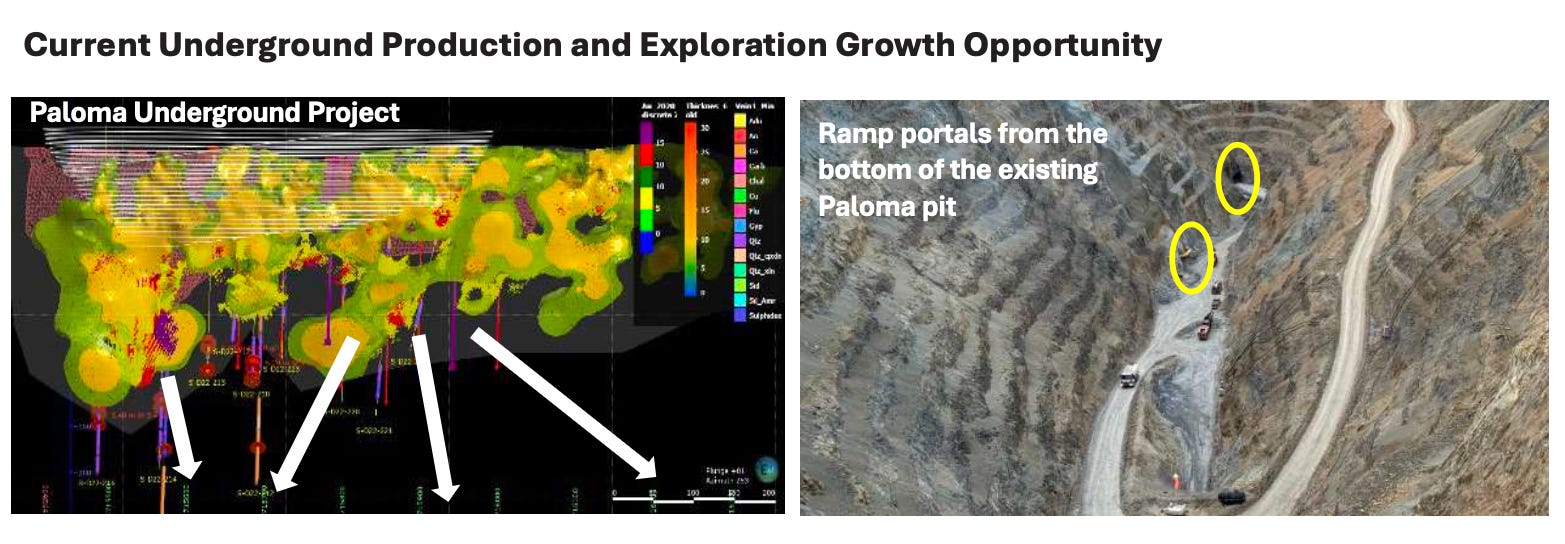
Among the areas attracting attention is Paloma, where underground development could provide access to mineralisation beneath previously mined areas.
Falcon is another target under evaluation. Cerrado has discussed a conceptual exploration target of approximately 150,000 to 200,000 ounces at grades of 0.8 to 1.1 grams per tonne.
Those figures are not a mineral resource estimate. Further drilling would be required to determine whether the target can support a resource, let alone a mine plan.
The underground programme could alter the operating profile of Minera Don Nicolás if it identifies sufficient economically recoverable material. Higher-grade underground ore may also provide a different feed source for the existing processing infrastructure.
Management is targeting an updated preliminary economic assessment in March 2027, incorporating drilling results through December 2026.
That study should provide a clearer indication of how the exploration results, processing changes and potential underground development might fit together.
When the Mine Begins Financing the Search
Exploration requires capital long before it produces revenue.
A company without an operating mine generally funds drilling through equity issuance, debt or asset transactions. Cerrado has access to another source: cash generated at Minera Don Nicolás.
That cash can support exploration without requiring a new equity raise for every drilling campaign. It is also being used to fund the acquisition and planned restart of Manantial Espejo, giving Cerrado an opportunity to expand production from within its existing Argentine business.
The stronger operating performance has coincided with additional external financing.
On 3 September, Cerrado closed a US$10 million strategic private placement involving Eric Sprott. The transaction comprised four million units priced at US$2.50 each, with each unit including one common share and half a warrant. Each whole warrant is exercisable at US$3.35 for two years.
The investment adds capital, although it also involves equity dilution and the possibility of further shares being issued through warrant exercise.
That financing forms part of a considerably larger investment programme. According to management, Cerrado has undertaken approximately US$45–50 million of capital expenditure and related investment during 2026, covering extensive drilling, expansion of the heap-leach and tailings facilities, equipment purchases and other operational improvements. The company has also repurchased royalties previously held by Sprott and eliminated equipment leases.
Much of this expenditure is intended to support production over several years rather than simply maintain current output. Management expects capital requirements to decline in 2027, with all-in sustaining costs potentially settling around US$1,800–1,900 per ounce.
If achieved, lower expenditure alongside sustained production could allow Cerrado to retain more of its operating cash flow, strengthen its balance sheet and finance further development without relying as heavily on external capital.
The next drilling results and updated economic assessment will help establish whether that investment is translating into a longer and more profitable operating life.
1.4 Million Ounces Later, a Second Life Begins
On 13 November, Cerrado announced the acquisition of Manantial Espejo, a past-producing gold and silver mine in Argentina’s Santa Cruz Province, from Pan American Silver.
The operation has an established production history.
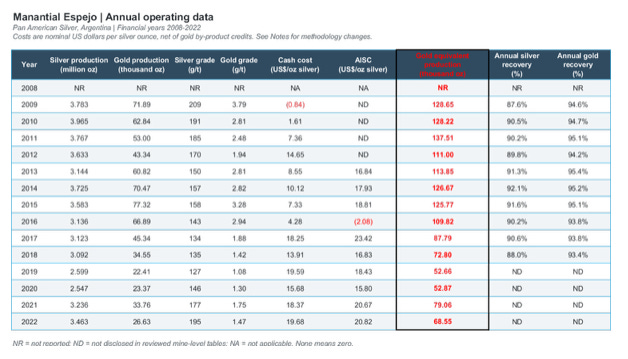
Between 2009 and 2016, Manantial Espejo produced between 110,000 and 137,500 gold-equivalent ounces annually. Output subsequently declined to between 52,000 and 88,000 ounces a year from 2017 to 2022, before mining ceased at the end of 2022.
Across its operating history, the mine produced approximately 1.4 million gold-equivalent ounces.
Importantly, the processing infrastructure remains in place. The property includes a mill with capacity for 2,500 tonnes per day, two former open pits and underground workings accessed through three portals.
Cerrado intends to restart production in 2027, beginning with dewatering and refurbishing the underground workings and existing infrastructure. The initial redevelopment phase is expected to take up to six months, with the mill initially targeting approximately 1,000 tonnes per day.
The company expects to begin processing existing low-grade stockpiles before introducing material from renewed underground mining.
The acquisition cost is US$20 million, comprising US$10 million paid at closing and two deferred payments of US$5 million. A further 1% net smelter returns royalty has been granted to Pan American Silver, while Cerrado has assumed the property’s existing liabilities, including closure obligations.
Minera Don Nicolás will provide the funding for the acquisition and restart. No new Cerrado shares were issued as transaction consideration.
There is also an exploration component. Cerrado plans approximately 40,000 metres of drilling at Manantial Espejo in 2027, with the objective of establishing an initial mineral resource estimate.
The company has identified historical mineralised material remaining in previously mined areas, although the property currently has no NI 43-101 compliant mineral resource or reserve estimate. No feasibility study has established the economics of restarting production, and Cerrado has not yet issued production guidance.
The acquisition therefore carries considerable technical and financial uncertainty.
What makes it particularly relevant to Cerrado is its location. Manantial Espejo sits in the same Argentine province as Minera Don Nicolás, allowing the company to draw on existing supplier relationships, procurement systems, local operating experience and technical expertise.
If the restart proceeds as planned, Cerrado could have two producing operations in Santa Cruz during 2027, while continuing to investigate the underground potential at both properties.
Portugal’s Unfinished Chapter
The company also holds an 80% interest in Lagoa Salgada, a polymetallic project in Portugal containing zinc, copper, lead, silver and gold mineralisation.
A 2023 feasibility study outlined an after-tax net present value of approximately US$147 million at an 8% discount rate, with an internal rate of return of 39%.
Those figures describe the economics under the assumptions used in that study. They are not a valuation of the project in its current circumstances.
Lagoa Salgada has faced uncertainty surrounding its environmental approval process, including legal proceedings and an injunction affecting the project’s permitting position.
Management nevertheless expects to file the next round of permit applications in December 2026, following what it describes as constructive discussions with the Portuguese government.
Cerrado is targeting permit approvals towards the end of the second quarter of 2027, potentially allowing construction to begin during the third quarter. An updated feasibility study is also expected in late December or early January.
These milestones remain dependent on regulatory decisions and the resolution of outstanding permitting matters. The proposed timetable should therefore be viewed as management’s objective rather than an established construction schedule.
For Cerrado, Portugal represents a potentially valuable asset that is not currently providing the same operational contribution as Minera Don Nicolás. Its future depends as much on regulatory and legal developments as on the economics described in the feasibility study.
The Iron Deposit Waiting in Québec
Another substantial component of Cerrado’s portfolio is Mont Sorcier, an iron ore project near Chibougamau in Québec.
Mont Sorcier is a different proposition from the company’s gold business.
The deposit contains magnetite mineralisation with the potential to produce a high-grade iron concentrate, including material suitable for consideration in direct-reduced iron production.
Interest in high-grade iron ore has grown alongside efforts to reduce emissions from steelmaking. Direct-reduced iron processes can offer an alternative to traditional blast-furnace production, although their environmental benefits depend heavily on the energy source and the wider steelmaking process.
A July 2022 preliminary economic assessment for Mont Sorcier outlined an after-tax net present value of approximately US$1.61 billion at an 8% discount rate and an internal rate of return of 43%, based on production of five million tonnes annually over a 21-year mine life.
Cerrado has subsequently examined a larger development concept involving approximately eight million tonnes of annual production. The economics of that larger concept have not been established by the earlier assessment.
The company has indicated that a bankable feasibility study is targeted for the first half of 2027, alongside work on infrastructure requirements and potential financing arrangements, including export-credit-agency support.
Mont Sorcier would require substantial investment before generating revenue. Its eventual economics will depend on updated engineering, capital costs, concentrate specifications, infrastructure and the market available for its product.
The project’s scale gives Cerrado exposure to a potentially much larger industrial development than its existing Argentine gold operation. It also introduces a very different set of financing and execution challenges.
The company’s dedicated technical teams allow work to continue across its different projects without requiring the Toronto office to manage each operation directly.
The more difficult question is financial: how much capital can Cerrado generate from Argentina, and how much external funding will ultimately be required to develop Portugal and Québec?
What Comes Next
Cerrado enters the final weeks of 2026 with higher production at Minera Don Nicolás, stronger cash generation and an extensive drilling programme underway.
The acquisition of Manantial Espejo has also changed the company’s immediate priorities.
Alongside the effort to extend the life of Minera Don Nicolás, Cerrado now has a second Argentine mine to refurbish, explore and potentially return to production in 2027.
The two operations could eventually provide a larger source of cash to support the company’s development projects in Portugal and Canada.
That is the sequence Cerrado is pursuing: generate cash from established mining operations, reinvest in additional production and use the proceeds to help finance larger projects.
The approach is not without risk. Manantial Espejo has no current compliant mineral resource or reserve estimate, and its restart economics have yet to be demonstrated. In Portugal, permitting remains unresolved. In Québec, Mont Sorcier will require substantial development capital.
Cerrado’s independent technical management teams allow work to continue across these projects, but their eventual development will depend on the company’s ability to finance them.
At Homestake, successive generations of miners followed mineralisation deeper into the Black Hills, extending the operation long beyond its early expectations. There was no certainty that the next workings would be productive. Each extension had to be established through exploration and development.
Minera Don Nicolás now faces its own version of that challenge. Cerrado has demonstrated that the operation can produce more gold. The drilling underway will help determine how many more years it can continue doing so.
And with Manantial Espejo now part of its portfolio, Cerrado has another opportunity to turn existing mining infrastructure and further exploration into additional years of production.
Disclosure: This article has been commissioned by Cerrado Gold (TSXV: CERT). The views expressed are that of Matt Oliver, Oliver Mining Network and reflect his own analysis. This article is provided for informational purposes only and does not constitute financial or investment advice. Investments are inherently speculative and involve risk, including the loss of capital.